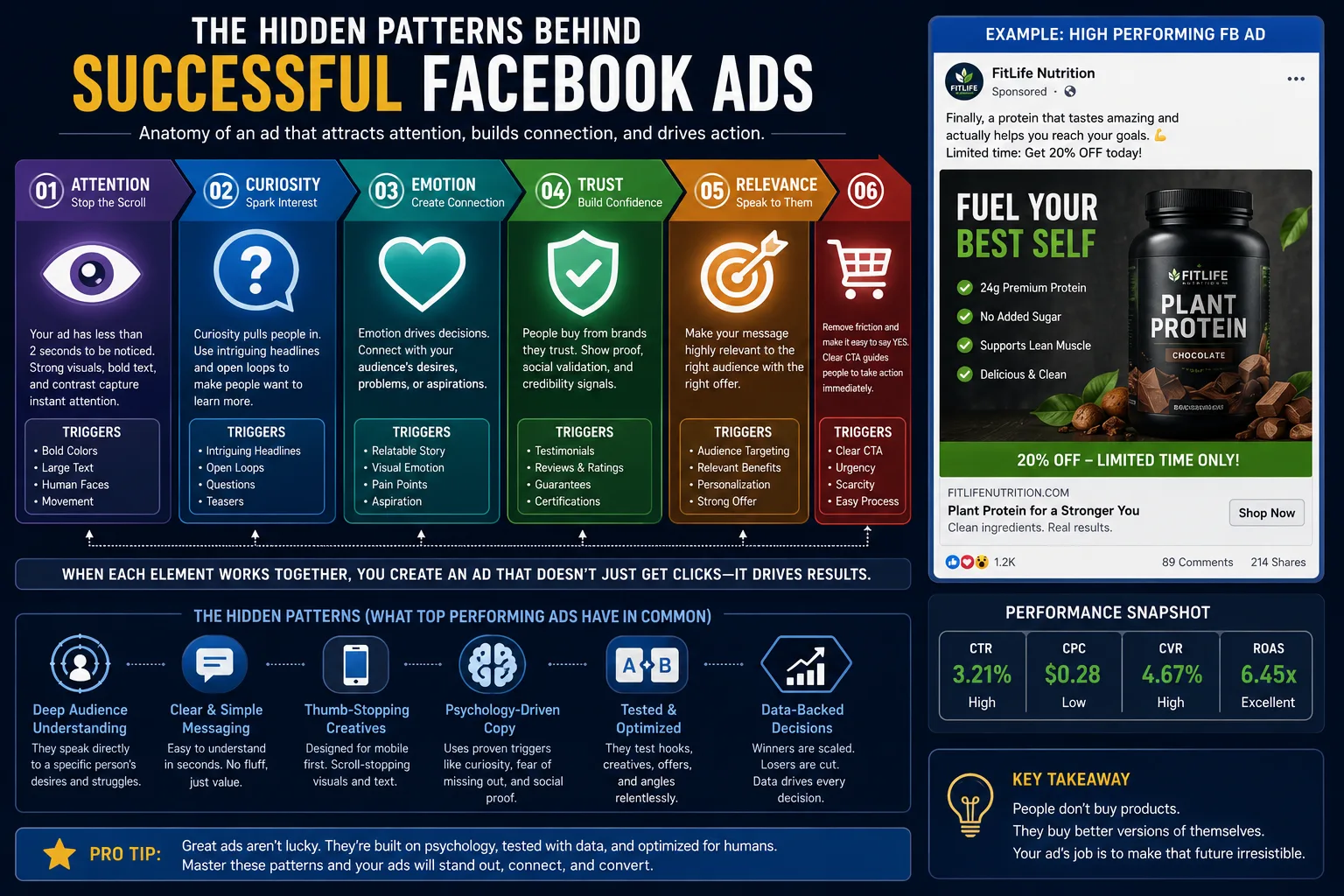

Every day, millions of Facebook ads compete for attention. Most are ignored. Some receive a few clicks. A small percentage generate thousands of clicks, leads, and sales.
At first glance, these successful Facebook ads may seem completely different. One might promote fitness products, another might sell software, while a third advertises real estate services.
However, when you study enough high-performing campaigns, something interesting emerges. The best Facebook ads often follow the same psychological principles. They understand how people think, what captures attention, and what motivates action. The creative may change. The offer may change. The audience may change.
Yet the underlying patterns remain surprisingly consistent.
Understanding these hidden patterns can help advertisers create better campaigns, improve engagement, and increase conversions without simply copying competitors.
Let’s explore what successful Facebook ads have in common.
Why Studying Successful Facebook Ads Matters
Many advertisers look at successful campaigns and focus on surface-level details.
They ask questions like:
- What image did they use?
- What headline worked?
- What color button generated clicks?
While those elements matter, they rarely explain why an advertisement succeeds.
The real value comes from understanding the principles behind performance.
When you understand the pattern, you can apply it across industries, products, and audiences.
That is where sustainable advertising success comes from.
Pattern #1: They Stop the Scroll Immediately
Facebook users scroll quickly. Most people decide within a fraction of a second whether an advertisement deserves attention. Successful Facebook ads understand this reality.
They create what marketers call a “scroll-stopping moment.”
This can be achieved through:
- Unexpected visuals
- Strong contrast
- Emotional imagery
- Intriguing headlines
- Surprising statistics
For example, an ad that starts with:
“Most businesses waste 30% of their advertising budget.”
is more likely to stop scrolling than:
“Learn more about our marketing services.”
The first creates curiosity.
The second sounds like an advertisement.
Pattern #2: They Speak to a Specific Audience
One of the biggest mistakes advertisers make is trying to appeal to everyone.
Successful Facebook ads do the opposite.
They focus on a clearly defined audience.
Consider these two examples:
Generic Message
“Our software helps businesses improve productivity.”
Targeted Message
“Our software helps remote teams save five hours every week.”
The second message feels more personal because it speaks directly to a specific group.
People pay attention when they feel understood.
The best Facebook ads make viewers think:
“This ad is talking to me.”
Pattern #3: They Focus on Benefits, Not Features
Customers rarely buy products because of features alone.
They buy outcomes.
Yet many advertisements spend too much time discussing features.
For example:
Feature
AI-powered reporting dashboard.
Benefit
Get business insights in seconds instead of spending hours creating reports.
The feature explains what the product does.
The benefit explains why the customer should care.
Successful Facebook ads consistently emphasize benefits over features.
Pattern #4: They Trigger Curiosity
Curiosity is one of the most powerful forces in advertising.
People naturally want to fill information gaps.
Successful Facebook ads often create these gaps intentionally.
Examples include:
- The mistake most advertisers make
- The strategy that doubled our conversions
- What happened after we changed one thing
These statements encourage people to learn more.
However, effective advertisers use curiosity responsibly.
The goal is to attract qualified interest, not create misleading clickbait.
Pattern #5: They Build Trust Quickly
Trust is often the difference between a click and a conversion.
Facebook users are exposed to countless advertisements every day.
As a result, skepticism is natural.
Successful Facebook ads reduce uncertainty through trust signals.
Common trust-building elements include:
- Customer testimonials
- Reviews and ratings
- Case studies
- Industry recognition
- User-generated content
- Statistics and data
People are more likely to act when they see evidence that others have already benefited.
Pattern #6: They Use Emotion Before Logic
Advertising is often viewed as a rational process.
In reality, emotions play a major role in decision-making.
People frequently make emotional decisions first and justify them later with logic.
Successful Facebook ads understand this principle.
Common emotional triggers include:
Aspiration
Showing people what they could become.
Security
Reducing fear and uncertainty.
Belonging
Helping people feel part of a community.
Achievement
Highlighting progress and success.
Relief
Offering solutions to frustrating problems.
Emotion captures attention.
Logic supports the decision.
The best advertisements use both.
Pattern #7: They Make the Next Step Obvious
Confusion kills conversions.
Successful Facebook ads provide clear direction.
The audience should immediately understand:
- What is being offered
- Why it matters
- What action to take next
Strong calls-to-action include:
- Learn More
- Start Free Trial
- Download Guide
- Book a Demo
- Shop Now
The simpler the decision process, the higher the likelihood of action.
Pattern #8: They Match the Customer’s Awareness Level
Not every customer is ready to buy immediately.
Some are just discovering a problem.
Others are comparing solutions.
A few are ready to make a purchase.
Successful Facebook ads match their message to the audience’s awareness level.
Problem Aware
The customer knows the problem exists.
Solution Aware
The customer understands possible solutions.
Product Aware
The customer knows your product exists.
Most Aware
The customer is close to purchasing.
Different stages require different messaging.
The most effective advertisers understand where their audience is in the buying journey.
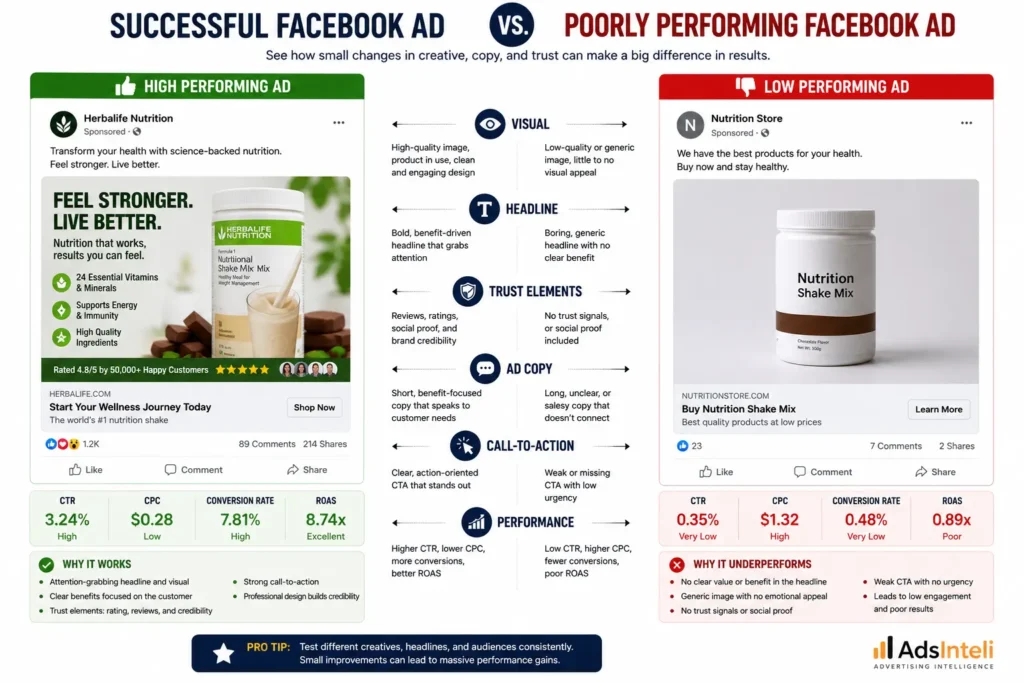
What Successful Facebook Ads Rarely Do
Interestingly, successful Facebook ads often avoid several common mistakes.
They rarely:
- Overload users with information
- Use excessive text
- Include multiple conflicting messages
- Rely entirely on stock photography
- Present unclear offers
- Ask users to take too many actions
Simplicity frequently outperforms complexity.
Why Copying Successful Ads Usually Fails
Many advertisers try to replicate successful campaigns.
Unfortunately, copying ads rarely produces the same results.
Why?
Because performance depends on:
- Audience
- Timing
- Offer
- Market conditions
- Brand reputation
- Customer intent
The visual design is only one piece of the puzzle.
Instead of copying ads, study the principles behind them.
Patterns are transferable.
Specific executions are not.
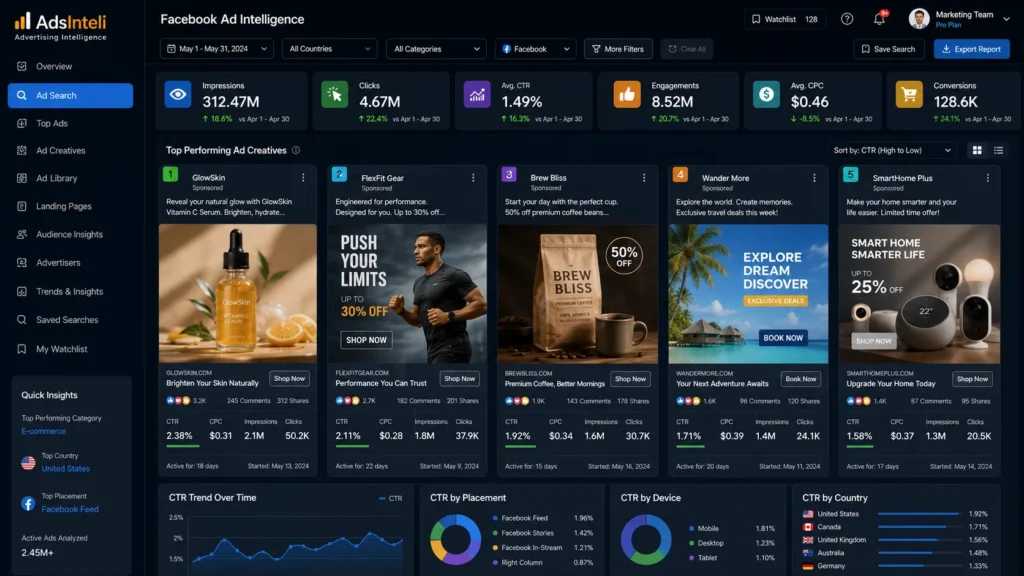
The Real Secret Behind Successful Facebook Ads
After analyzing countless high-performing campaigns, one conclusion becomes clear.
Successful Facebook ads are not built around tricks.
They are built around understanding people.
They consistently:
- Capture attention
- Create relevance
- Build trust
- Trigger emotion
- Communicate value
- Simplify decisions
The platforms may change.
Algorithms may evolve.
Human psychology remains remarkably consistent.
Advertisers who understand people gain a lasting advantage.
Common Myths
Myth 1: Successful Facebook Ads Need Huge Budgets
Many small businesses achieve excellent results through smart targeting and strong messaging.
Myth 2: Beautiful Design Guarantees Success
Design helps, but relevance and value matter more.
Myth 3: Copying Competitors Leads to Better Results
Studying competitors is useful. Copying them rarely creates sustainable success.
Read More Articles on Social Media Advertising
Key Takeaways
- Successful Facebook ads follow recognizable psychological patterns.
- Attention is the first battle every advertisement must win.
- Specific messaging outperforms generic messaging.
- Benefits matter more than features.
- Trust significantly influences performance.
- Emotion often drives action.
- Simplicity improves conversion rates.
- Understanding customer psychology creates long-term advantages.
Conclusion
The most successful Facebook ads are not random successes.
Behind every high-performing campaign lies a combination of proven principles, audience understanding, emotional triggers, and strategic communication.
While creative formats and advertising trends continue to evolve, the foundations of effective advertising remain remarkably stable.
The advertisers who consistently win are not necessarily the ones with the largest budgets.
They are the ones who understand what captures attention, builds trust, and motivates action.
That is the hidden pattern behind successful Facebook ads—and it is a lesson that extends far beyond Facebook itself.
FAQ
What makes a Facebook ad successful?
A successful Facebook ad captures attention, communicates value, builds trust, and encourages action.
Do successful Facebook ads always use video?
No. Both images and videos can perform well when they match audience preferences and campaign objectives.
How important is ad copy in Facebook advertising?
Ad copy plays a major role in creating relevance, curiosity, and emotional connection.
Should businesses copy successful Facebook ads?
It is better to study the principles behind successful ads rather than copy them directly.
What is the most important element of a Facebook ad?
Relevance is often the most important factor. An ad that speaks directly to the right audience usually performs better than a generic message.