
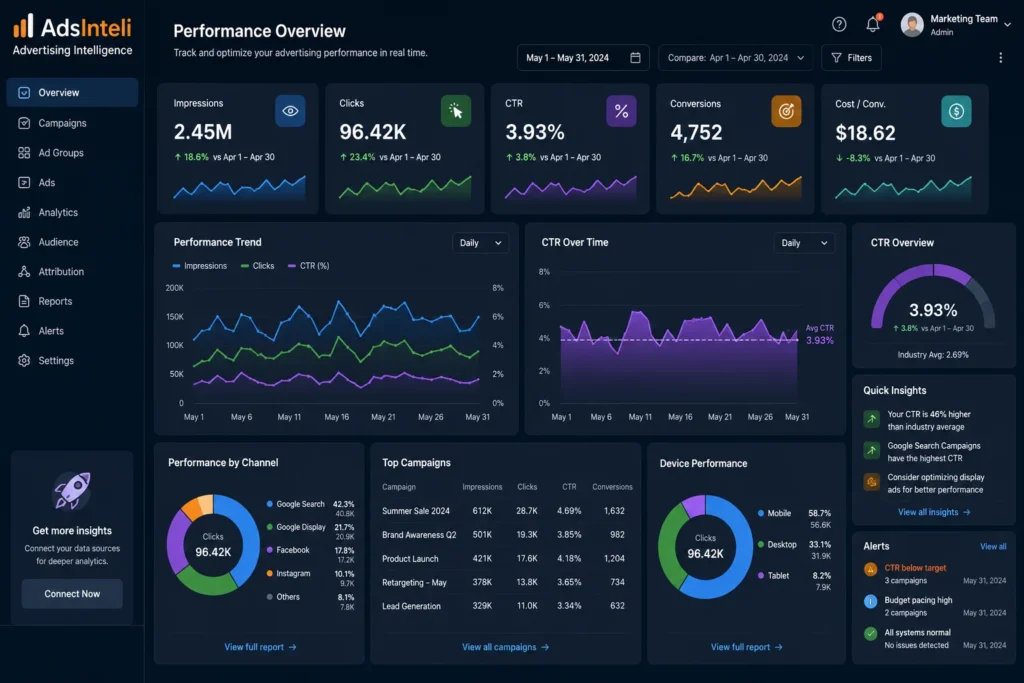
A high Click Through Rate can make advertisers feel like they’re winning. The dashboard looks impressive. Clicks are increasing. The CTR graph is moving upward. At first glance, it seems like the campaign is performing well. But here’s the uncomfortable truth: many advertising campaigns with excellent CTRs fail to generate meaningful business results. Likewise, some campaigns with average or even below-average CTRs produce outstanding revenue and profitability.
This is why Click Through Rate remains one of the most important and most misunderstood metrics in advertising.
Understanding the relationship between CTR and ad performance can help marketers avoid costly mistakes, allocate budgets more effectively, and make better optimization decisions.
Let’s explore the truth behind the metric that advertisers obsess over every day.
Read More Articles on Advertising Fundamentals
What Is Click Through Rate?
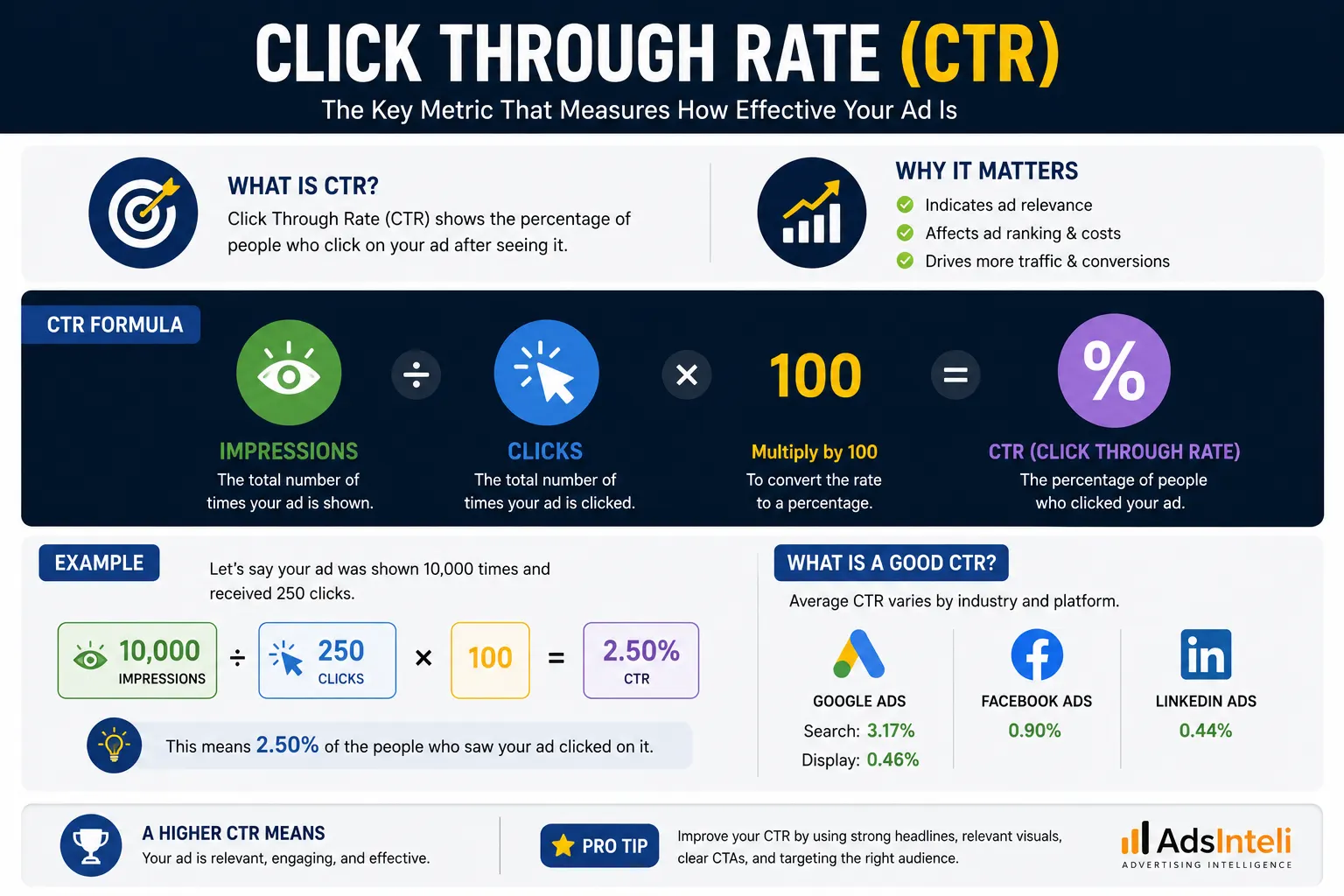
Click Through Rate (CTR) measures the percentage of people who click on an advertisement after seeing it.
The formula is simple:
CTR = (Clicks ÷ Impressions) × 100
For example:
- 10,000 impressions
- 500 clicks
CTR = 5%
The metric tells advertisers how effective an ad is at generating interest and engagement.
However, that’s only part of the story.
Why Advertisers Love CTR
CTR is easy to understand.
Unlike more advanced metrics, it provides immediate feedback.
When an ad receives a high CTR, it usually means:
- The creative attracted attention
- The headline created curiosity
- The audience found the message relevant
- The call-to-action encouraged action
Because of this, CTR often becomes the first metric marketers check after launching a campaign.
A strong CTR feels like validation.
But that validation can sometimes be misleading.
The Biggest CTR Myth in Advertising
One of the most common beliefs in digital marketing is:
Higher CTR = Better Campaign
Unfortunately, this isn’t always true.
A high CTR simply indicates that people clicked.
It does not tell you:
- Whether visitors became customers
- Whether sales increased
- Whether revenue improved
- Whether the campaign was profitable
CTR measures attention.
It does not measure business success.
Many marketers confuse these two concepts.
That’s where problems begin.
When a High CTR Can Be Bad
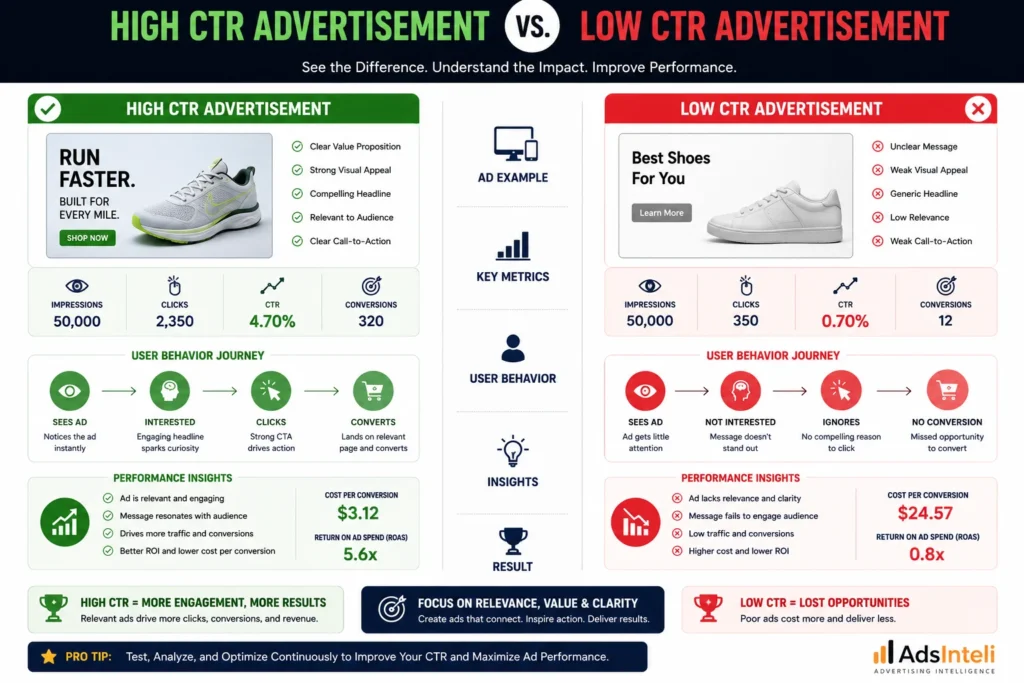
Imagine two advertising campaigns.
Campaign A
- Impressions: 100,000
- Clicks: 12,000
- CTR: 12%
- Conversions: 60
Campaign B
- Impressions: 100,000
- Clicks: 3,000
- CTR: 3%
- Conversions: 300
Most advertisers would initially celebrate Campaign A.
After all, the CTR is four times higher.
However, Campaign B generated five times more customers.
The campaign with the lower CTR produced significantly better business results.
This happens more often than many marketers realize.
Clicks Do Not Equal Customers
People click for many reasons.
Some are genuinely interested.
Others are simply curious.
Some click accidentally.
Others click because the advertisement promises something exciting that the landing page fails to deliver.
A campaign can attract thousands of clicks and still fail if those visitors are not qualified prospects.
This is why focusing exclusively on CTR can become dangerous.
The goal of advertising is not generating clicks.
The goal is generating outcomes.
The Truth About CTR and Ad Performance
CTR is best viewed as an attention metric.
It answers one question:
“Did people find the advertisement interesting enough to click?”
It does not answer:
- Did they buy?
- Did they subscribe?
- Did they book a demo?
- Did they become loyal customers?
Those questions require different metrics.
Many advertisers treat CTR as a final score.
In reality, it is only the beginning of the journey.
Think of CTR as the front door.
What happens after someone walks through that door matters far more.
Why Some Low CTR Campaigns Perform Better
Many high-intent campaigns naturally produce lower CTRs.
Consider a B2B software company selling enterprise solutions worth ₹10 lakh or more.
The audience is smaller.
The decision-making process is longer.
The product appeals to a very specific group of people.
As a result:
- Fewer people click
- But those who click are highly qualified
Even with a modest CTR, such campaigns can generate substantial revenue.
This is why experienced advertisers care more about click quality than click quantity.
The Metrics Smart Advertisers Track Beyond CTR
Successful marketers rarely evaluate campaigns using CTR alone.
Instead, they examine a combination of metrics.
Conversion Rate
Measures how many visitors complete the desired action.
Examples:
- Purchases
- Sign-ups
- Leads
- App installs
Cost Per Acquisition (CPA)
Shows how much it costs to acquire a customer.
A campaign with a lower CTR but lower CPA may be far more profitable.
Return on Ad Spend (ROAS)
One of the most important performance metrics.
ROAS measures revenue generated relative to advertising spend.
This is where real business impact becomes visible.
Customer Lifetime Value (CLV)
Some customers purchase repeatedly.
Others buy once and disappear.
CTR cannot reveal this difference.
Customer Lifetime Value can.
How High CTR Can Actually Hurt Performance
Many advertisers optimize campaigns aggressively for clicks.
This can create unintended consequences.
For example:
- Sensational headlines
- Clickbait messaging
- Misleading offers
- Overpromising results
Such tactics often increase CTR.
However, they can also:
- Reduce trust
- Increase bounce rates
- Lower conversion rates
- Waste advertising budget
A campaign that attracts the wrong audience is rarely successful, regardless of CTR.
How to Improve CTR Without Sacrificing Conversions
The best advertisers improve CTR while maintaining lead quality.
Here are a few proven approaches:
Improve Audience Targeting
Better targeting attracts more relevant visitors.
Relevant audiences usually produce stronger CTR and better conversions.
Strengthen the Value Proposition
Clearly communicate:
- Benefits
- Outcomes
- Solutions
People click when they understand what’s in it for them.
Test Multiple Headlines
Small headline changes can dramatically affect CTR.
Experiment regularly.
Align Ads and Landing Pages
The promise made in the advertisement should match the landing page experience.
Consistency improves trust and conversion rates.
Focus on Qualified Clicks
Not every click has equal value.
Optimize for the right audience rather than the largest audience.
Common Myths About Click Through Rate
Myth 1: High CTR Means High Revenue
Reality: Revenue depends on conversions, not clicks.
Myth 2: CTR Is the Most Important Advertising Metric
Reality: CTR is important, but metrics like ROAS and CPA often provide deeper business insights.
Myth 3: Low CTR Always Means Poor Performance
Reality: Some highly profitable campaigns operate with relatively modest CTRs.
Key Takeaways
- CTR measures attention, not business success.
- High CTR does not guarantee profitability.
- Qualified clicks are more valuable than large numbers of clicks.
- Conversion Rate, CPA, and ROAS provide deeper insights.
- Some low-CTR campaigns outperform high-CTR campaigns financially.
- Smart advertisers evaluate the entire customer journey.
Conclusion
Click Through Rate is an important advertising metric, but it should never be viewed in isolation.
A strong CTR tells you that your ad successfully captured attention. That’s valuable information.
However, attention alone does not pay the bills.
Real advertising success comes from converting that attention into leads, customers, revenue, and long-term growth.
The next time you review a campaign dashboard, resist the temptation to celebrate CTR alone.
Instead, ask a more important question:
Did those clicks create real business results?
That’s where the truth about ad performance begins.
FAQ
What is a good Click Through Rate?
A good CTR depends on the platform, industry, audience, and campaign objective.
Does a high CTR guarantee conversions?
No. High CTR indicates interest, but not necessarily purchase intent.
Why is CTR important in advertising?
CTR helps advertisers understand whether their ads attract attention and engagement.
What metric is more important than CTR?
Metrics such as Conversion Rate, CPA, and ROAS often provide a clearer picture of campaign success.
Can low CTR campaigns still be profitable?
Yes. Many high-intent campaigns generate excellent results despite modest CTRs.
Read More Articles on Advertising Glossary Series:
/advertising-glossary/