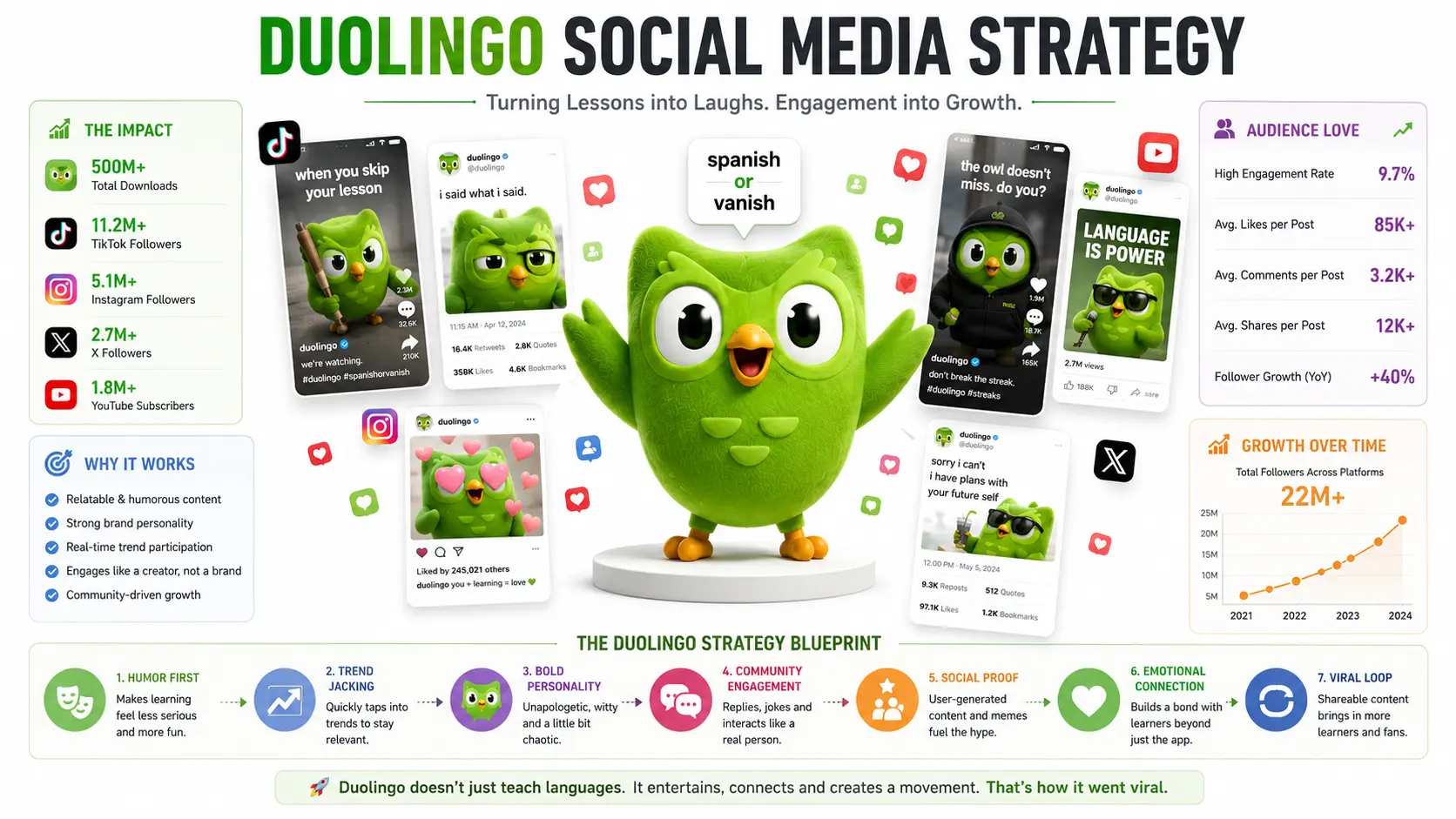

Duolingo’s Social Media Strategy is one of the most fascinating marketing success stories of the modern digital era.
Just a few years ago, Duolingo was known primarily as a language-learning app.
Today, it is one of the most recognizable brands on social media.
Its mascot appears across TikTok, Instagram, YouTube Shorts, X, and other platforms.
Millions of users engage with its content regularly.
Many people who have never used Duolingo still recognize the brand.
That level of awareness did not happen by accident.
The Duolingo Social Media Strategy combined humor, personality, internet culture, and consistent content creation to transform a language-learning app into a viral marketing phenomenon.
In a world where many brands struggle to gain attention online, Duolingo discovered how to make people voluntarily engage with marketing content.
The result was explosive growth, massive brand awareness, and one of the most successful examples of organic social media marketing in recent years.
Why Duolingo Needed a Different Marketing Strategy
Language learning is not typically considered exciting.
Most educational brands face similar challenges:
- Limited excitement
- Low social sharing
- High competition
- Short attention spans
Traditional marketing often focuses on:
- Product features
- Learning outcomes
- Educational benefits
However, these messages rarely go viral.
Duolingo understood something important.
People do not visit social media platforms to consume advertisements.
They visit to be entertained.
This insight became the foundation of the Duolingo Social Media Strategy.
The Birth of Duolingo’s Social Media Personality
One of the biggest reasons behind the success of the Duolingo Social Media Strategy was the creation of a memorable brand personality.
Most brands sound corporate.
Duolingo chose a different path.
The company transformed its mascot, Duo the Owl, into an internet personality.
Instead of acting like a language-learning company, Duo behaved like a humorous social media creator.
The mascot became:
- Funny
- Self-aware
- Relatable
- Occasionally chaotic
- Highly entertaining
This approach made Duolingo feel more human.
People stopped interacting with a company.
They started interacting with a personality.
How Humor Became Duolingo’s Competitive Advantage
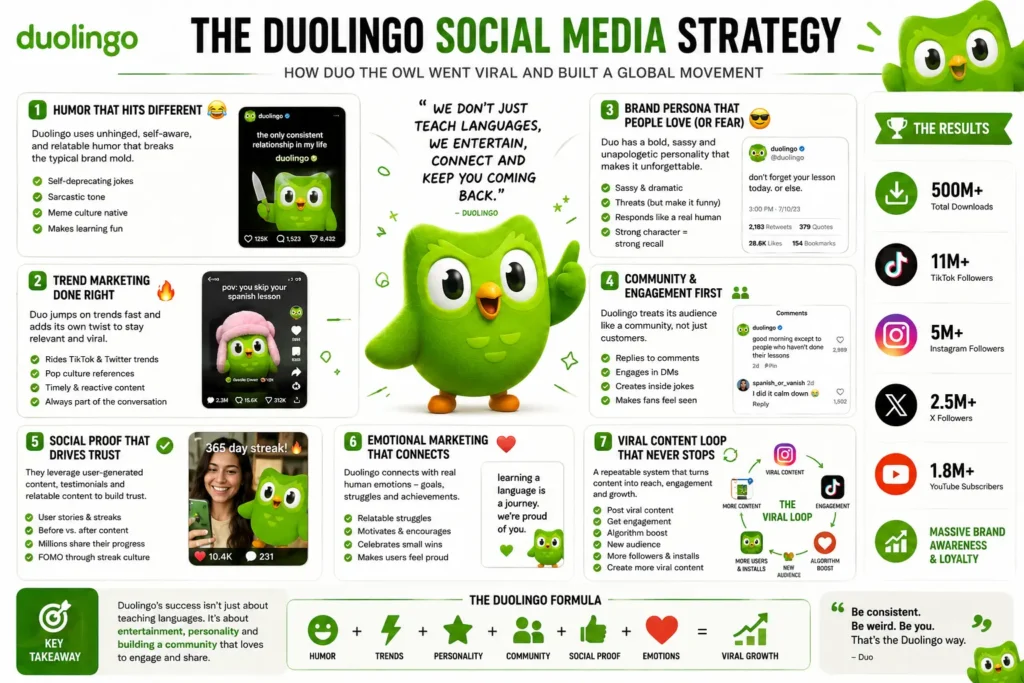
Humor sits at the heart of the Duolingo Social Media Strategy.
Many educational brands create serious content.
Duolingo embraced entertainment.
Examples include:
- Trending memes
- Viral jokes
- Self-deprecating humor
- Pop culture references
- Playful interactions
The company understood that humor creates:
- Attention
- Shares
- Comments
- Emotional engagement
Humor also reduces resistance to marketing.
People willingly consume entertaining content.
Even when it comes from a brand.
This approach aligns closely with principles discussed in:
- Emotional Marketing: Why Great Ads Make You Feel Something
- Social Proof Marketing: The Hidden Reason People Follow the Crowd
The Power of Duo the Owl
Every great brand has recognizable assets.
For Coca-Cola, it is the red branding.
For Nike, it is the swoosh.
For Apple, it is simplicity and design.
For Duolingo, it is Duo the Owl.
The mascot became central to the Duolingo Social Media Strategy.
Duo was no longer simply a logo.
It became a character.
A character can:
- Tell stories
- Participate in trends
- Interact with users
- Create emotional connections
This gave Duolingo a massive advantage over competitors.
Why TikTok Changed Everything
The success of the Duolingo Social Media Strategy accelerated dramatically with TikTok.
TikTok rewards:
- Creativity
- Authenticity
- Personality
- Entertainment
Traditional advertisements often perform poorly on TikTok.
Duolingo adapted perfectly.
Instead of creating polished advertisements, the company created native platform content.
The videos felt like TikToks first.
Marketing second.
This distinction is important.
People share content they enjoy.
Not content that feels like an advertisement.
The Psychology Behind Duolingo’s Viral Growth
Several psychological principles explain why the Duolingo Social Media Strategy worked so well.
Emotional Marketing
Duolingo creates emotions.
People laugh.
People feel surprised.
People feel entertained.
These emotional reactions increase engagement.
Social Proof
Millions of views create credibility.
As more people interact with content, others join the conversation.
This creates a powerful social proof loop.
Consistency
Duolingo posts frequently.
Consistency builds familiarity.
Familiarity builds trust.
Trust builds brand recognition.
Community Participation
Rather than broadcasting messages, Duolingo participates in internet culture.
The brand joins conversations instead of interrupting them.
Read More Articles on Social Media Marketing
The Role of Trend Marketing
A major part of the Duolingo Social Media Strategy involves trend adoption.
The social media team constantly monitors:
- Viral sounds
- Popular formats
- Trending memes
- Internet culture
When trends appear, Duolingo adapts quickly.
This allows the brand to remain relevant.
However, the company does not blindly follow trends.
It adapts trends to fit its personality.
This distinction is critical.
Why Duolingo Rarely Focuses on Product Features
Most companies make a common mistake.
They constantly talk about themselves.
Duolingo focuses on attention first.
The company understands:
No attention = No awareness.
No awareness = No growth.
By entertaining audiences, Duolingo earns attention.
Once attention is established, product discovery happens naturally.
This is similar to what Coca-Cola achieved through emotional branding.
Read:
- How Coca-Cola Sold Happiness to the World
What Marketers Can Learn From Duolingo’s Viral Growth
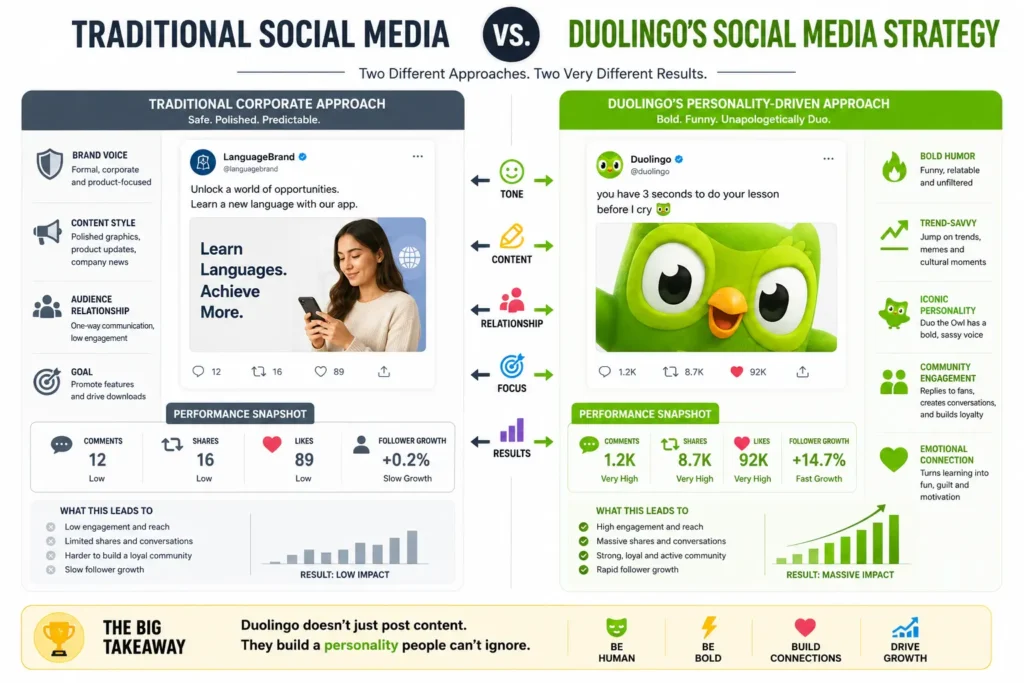
The success of the Duolingo Social Media Strategy offers several lessons.
Be Human
People connect with personalities more than corporations.
Entertain Before You Sell
Attention comes before conversion.
Embrace Platform Culture
Each platform has unique expectations.
Successful brands adapt accordingly.
Consistency Matters
Viral moments are valuable.
Consistent posting is essential.
Build Distinctive Brand Assets
Mascots, colors, voices, and personalities improve recognition.
Common Mistakes Brands Make
Many companies try to copy Duolingo.
Most fail.
Why?
Because they copy the tactics.
Not the strategy.
Mistakes include:
Forced Humor
Humor must feel natural.
Trend Chasing
Not every trend fits every brand.
Lack of Consistency
Posting once a month is not a strategy.
Ignoring Brand Identity
Every post should reinforce the brand.
The Future of Duolingo’s Social Media Strategy
As platforms evolve, the tactics may change.
However, the principles behind the Duolingo Social Media Strategy are likely to remain relevant.
Those principles include:
- Authenticity
- Personality
- Entertainment
- Community engagement
- Consistency
These factors are not platform-specific.
They are human-specific.
That is why they continue to work.
Key Takeaways
- Duolingo Social Media Strategy transformed an educational app into a viral internet brand.
- Duo the Owl became a recognizable brand personality.
- Humor played a central role in content performance.
- TikTok accelerated Duolingo’s growth through native platform content.
- Emotional engagement increased brand awareness.
- Social proof amplified visibility and reach.
- Consistency helped build long-term recognition.
- Successful social media marketing focuses on attention before promotion.
Conclusion – Duolingo’s Viral Growth
The Duolingo Social Media Strategy demonstrates that great marketing is not always about bigger budgets.
Sometimes it is about understanding people.
Duolingo recognized that social media users want entertainment, authenticity, and connection.
Instead of fighting platform culture, the company embraced it.
Instead of acting like a corporation, it acted like a creator.
Instead of pushing advertisements, it created content people wanted to share.
The result was one of the most successful examples of social media marketing in recent years.
For marketers, the lesson is clear:
The brands that win on social media are not always the ones with the biggest budgets.
They are the ones that understand how people behave online.
FAQ
What is the Duolingo Social Media Strategy behinf Duolingo’s Viral Growth?
The Duolingo Social Media Strategy focuses on humor, personality, trend participation, and platform-native content to build engagement and brand awareness.
Why did Duolingo become viral on TikTok?
Duolingo became viral by creating entertaining content that matched TikTok culture instead of traditional advertisements.
Who is Duo the Owl?
Duo the Owl is Duolingo’s mascot and one of the key brand assets driving the company’s social media success.
What can marketers learn from Duolingo’s Viral Growth?
Marketers can learn the importance of personality, consistency, authenticity, and entertainment-driven content.
Does Duolingo rely on paid advertising?
Duolingo uses advertising, but much of its social media success comes from organic engagement and viral content.