
Many Choices seem like a good thing.
After all, customers often say they want more options, more flexibility, and more control over their buying decisions. Businesses frequently respond by expanding product catalogs, adding pricing plans, and creating countless variations of the same offering.
At first glance, this approach makes sense.
If customers have more options, they should be more likely to find something they like.
Right?
Surprisingly, the opposite is often true.
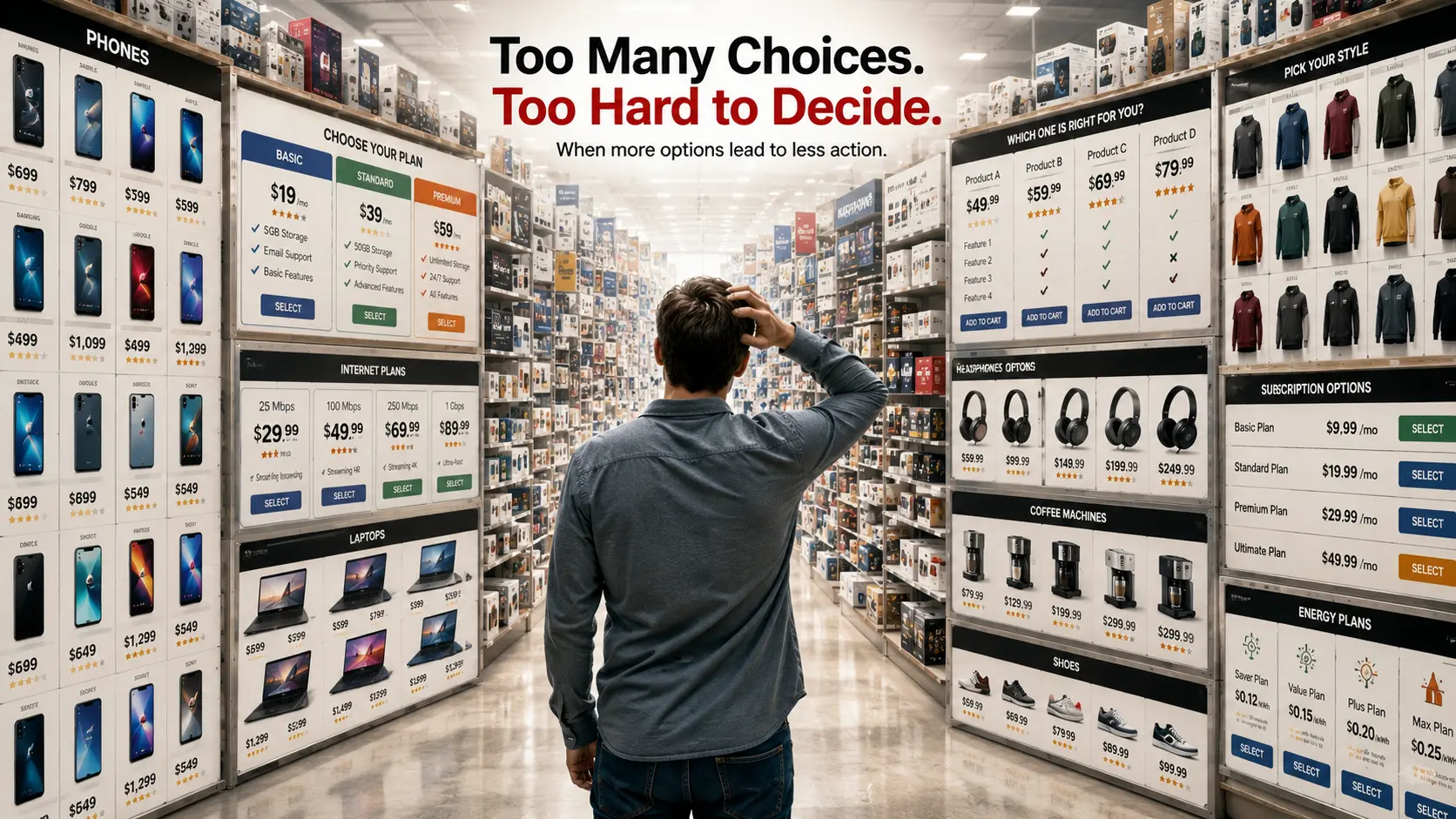
Research in consumer psychology has repeatedly shown that Many Choices can overwhelm consumers, create decision fatigue, reduce confidence, and ultimately decrease sales.
This phenomenon, known as choice overload, helps explain why some of the world’s most successful companies intentionally simplify customer decisions rather than expand them.
Understanding why Many Choices can hurt sales is essential for marketers, advertisers, e-commerce businesses, SaaS companies, and anyone involved in influencing purchasing decisions.
Why Many Choices Feel Attractive to Businesses
Most businesses assume that increasing options increases customer satisfaction.
The logic appears straightforward.
More options should mean:
- More personalization
- More flexibility
- More customer control
- More opportunities to purchase
As a result, companies often expand their offerings.
A software company creates ten pricing plans.
A restaurant expands its menu to dozens of pages.
An e-commerce store adds hundreds of nearly identical products.
The intention is good.
However, consumer psychology often works differently than expected.
Customers don’t always want more options.
They want easier decisions.
The Psychology Behind Many Choices
The human brain is remarkably efficient.
To conserve mental energy, it relies on shortcuts when making decisions.
Every decision requires effort.
When consumers encounter Many Choices, the brain must:
- Compare alternatives
- Evaluate differences
- Assess risks
- Predict outcomes
- Justify decisions
The more options available, the more mental effort is required.
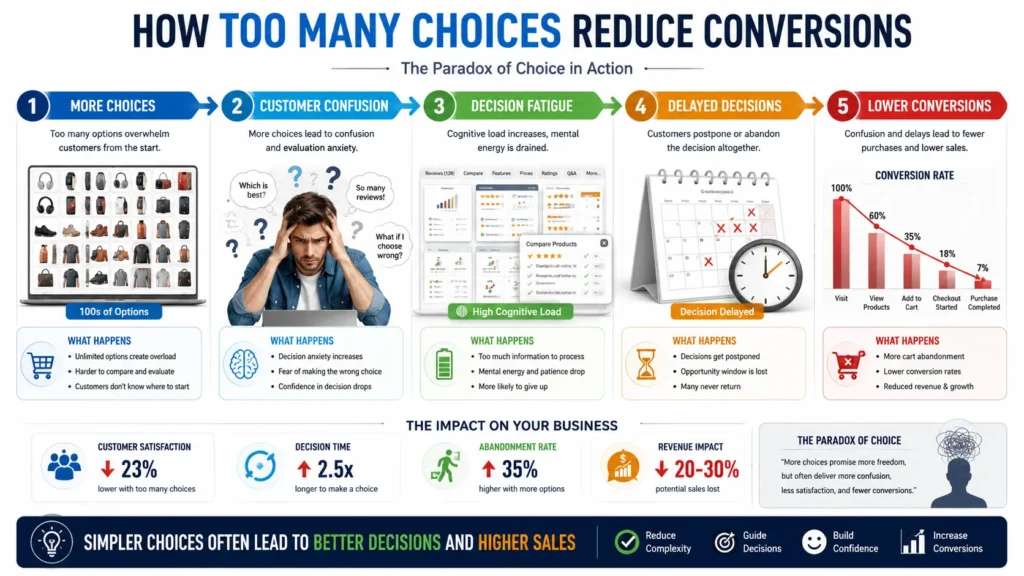
Eventually, consumers experience what psychologists call cognitive overload.
When this happens, decision quality decreases and purchasing behavior changes.
How Many Choices Create Decision Fatigue
Decision fatigue occurs when the mental energy required to make decisions becomes overwhelming.
Imagine entering a restaurant.
Scenario A:
The menu contains 8 items.
Scenario B:
The menu contains 180 items.
Which menu feels easier?
Most people prefer the simpler option.
The larger menu may offer greater variety, but it also requires significantly more mental effort.
Consumers begin asking:
- Which option is best?
- Am I missing something better?
- What if I make the wrong choice?
As uncertainty increases, confidence decreases.
This is one of the biggest reasons Many Choices often hurt sales.
Why Many Choices Can Reduce Sales
The relationship between options and conversions is not linear.
More options do not automatically create more purchases.
In many cases, they create fewer purchases.
There are several reasons for this.
Analysis Paralysis
When consumers face too many options, they spend more time evaluating alternatives.
Instead of making a decision, they continue comparing.
Eventually, they postpone the decision entirely.
No purchase occurs.
Fear of Making the Wrong Choices
The more options consumers have, the greater the perceived risk of selecting the wrong one.
Consumers start worrying:
- What if another option is better?
- What if I regret my decision?
- What if I should keep looking?
This fear often delays action.
Reduced Satisfaction
Ironically, more options can reduce satisfaction after a purchase.
Consumers continue wondering whether another choice would have been better.
This phenomenon is closely connected to Loss Aversion Marketing, where consumers fear making mistakes and losing opportunities.
The Famous Jam Experiment and Many Choices
One of the most famous studies on choice overload involved jam.
Researchers set up tasting booths in a grocery store.
One booth displayed:
- 24 varieties of jam
Another booth displayed:
- 6 varieties of jam
The larger display attracted more attention.
More people stopped.
More people looked.
However, when it came to actual purchases, the smaller display dramatically outperformed the larger one.
Consumers were far more likely to buy when presented with fewer choices.
The lesson was clear:
Attention does not always translate into action.
Sometimes Many Choices increase interest but decrease conversions.
Real-World Examples of Many Choices
Netflix
Netflix offers thousands of titles.
To prevent choice overload, Netflix uses:
- Recommendations
- Categories
- Personalized suggestions
Without these tools, consumers would struggle to choose.
Netflix understands that Many Choices require guidance.
Amazon
Amazon sells millions of products.
Rather than forcing consumers to evaluate everything, Amazon uses:
- Best Seller labels
- Reviews
- Recommendations
- Sponsored products
These features simplify decisions.
SaaS Pricing Pages
Many software companies initially create numerous pricing tiers.
Over time, successful companies often simplify pricing.
Three plans frequently outperform ten plans because consumers can make decisions more confidently.
Read More Articles on Advertising Psychology
Restaurant Menus
Restaurants with extremely large menus often create confusion.
Many successful restaurants intentionally limit options.
Fewer choices create faster decisions and improve customer satisfaction.
Insurance Plans
Insurance companies frequently overwhelm customers with complicated plans and features.
Consumers often delay decisions because evaluating every option becomes exhausting.
This is why many insurers now offer simplified packages.
Many Choices vs Customer Confidence
Confidence plays a major role in purchasing decisions.
When consumers feel confident, they buy.
When consumers feel uncertain, they hesitate.
Many Choices often reduce confidence because consumers struggle to identify the best option.
The goal of marketing is not to maximize options.
The goal is to maximize confidence.
This is an important distinction.
When Many Choices Actually Help
Not all choice is bad.
In some situations, variety creates value.
Examples include:
- Fashion retailers
- Streaming platforms
- Travel websites
- Marketplaces
However, successful businesses still organize and simplify options.
They guide consumers toward decisions rather than forcing them to evaluate everything independently.
When Many Choices Hurt Conversions
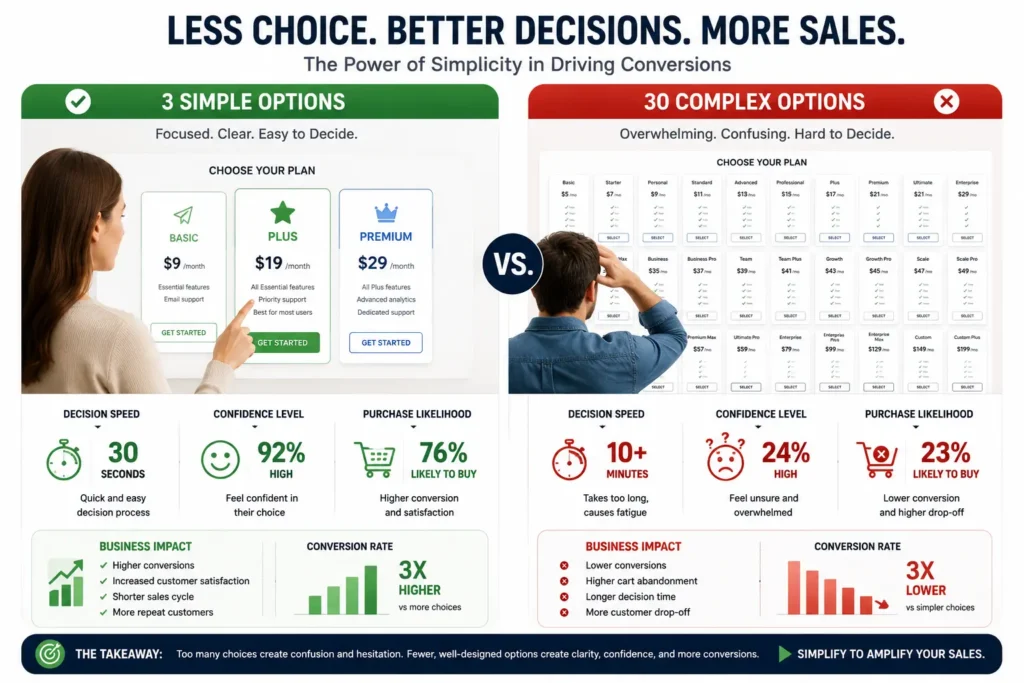
Choice overload is most damaging when:
- Products are complex
- Differences are unclear
- Consumers lack expertise
- Decisions involve risk
- Options appear similar
In these situations, simplifying decisions often increases conversions.
What Marketers Can Learn From Many Choices
One of the biggest lessons from consumer psychology is that simplicity sells.
Instead of asking:
“How can we add more options?”
Marketers should ask:
“How can we make decisions easier?”
Strategies include:
- Reducing unnecessary options
- Highlighting recommended choices
- Using comparison tables
- Creating clear categories
- Simplifying pricing structures
Many successful companies grow not by offering more options, but by reducing complexity.
How Many Choices Connect to Other Advertising Psychology Principles
Choice overload does not exist in isolation.
It works alongside other psychological principles.
Anchoring Marketing
Consumers use the first option they see as a reference point.
Read: Anchoring Marketing: Why the First Price Matters Most
Scarcity Marketing
Limited options can increase perceived value.
Read: Scarcity Marketing: Why Limited Offers Feel More Valuable
Loss Aversion Marketing
Consumers fear making the wrong decision.
Read: Loss Aversion Marketing: The Hidden Reason People Hate Losing
Emotional Marketing
Emotions influence decisions when consumers feel overwhelmed.
Read: Emotional Marketing: Why Great Ads Make You Feel Something
Common Myths About Many Choices
Myth 1: More Options Always Mean More Sales
Reality: More options often create confusion.
Myth 2: Customers Always Want Maximum Choice
Reality: Customers want the right amount of choice.
Myth 3: Choices Overload Only Affects Retail
Reality: It affects SaaS, insurance, education, finance, travel, and many other industries.
Myth 4: More Products Improve Customer Experience
Reality: Simplicity often improves customer experience more effectively.
Key Takeaways
- Many Choices can create decision fatigue.
- More options do not always increase conversions.
- Consumers often prefer simpler decisions.
- Choice overload can reduce confidence and satisfaction.
- Successful brands simplify decisions rather than complicate them.
- Guidance and recommendations help consumers navigate large selections.
- Simplicity is often a competitive advantage.
Conclusion
At first glance, offering more options seems like a customer-friendly strategy.
However, consumer psychology tells a different story.
While consumers appreciate variety, they also value simplicity, clarity, and confidence.
Too many options can overwhelm decision-making, create uncertainty, and reduce conversions.
That is why many successful businesses focus not on increasing choices, but on improving decision-making.
The next time sales decline despite expanding product offerings, consider a surprising possibility:
The problem may not be too few options.
It may be too many.
Understanding why Many Choices can hurt sales helps marketers create better customer experiences, stronger conversions, and more effective advertising strategies.
FAQ
Why do many choices reduce sales?
Many Choices can create decision fatigue, increase uncertainty, and make purchasing decisions more difficult, leading consumers to delay or avoid purchases.
What is choices overload?
Choice overload is a psychological phenomenon where too many options make decision-making harder and reduce consumer confidence.
How does decision fatigue affect consumers?
Decision fatigue reduces mental energy, making consumers more likely to postpone decisions or choose nothing at all.
Can many choices ever improve conversions?
Yes. Many Choices can help when products are organized, recommendations are provided, and decision-making remains simple.
How can businesses reduce choices overload?
Businesses can simplify pricing, reduce unnecessary options, highlight recommended products, and create clearer categories.