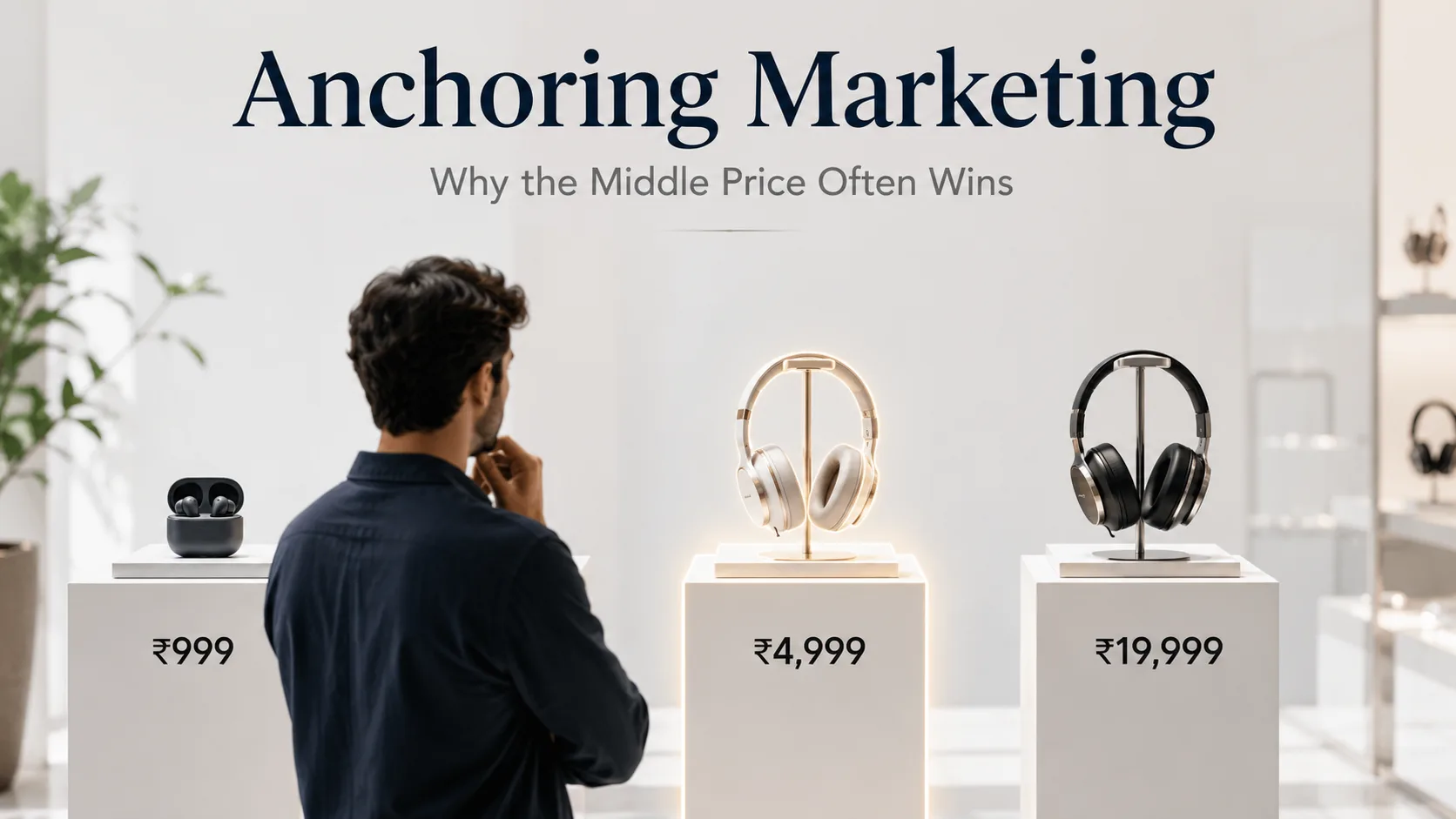

Anchoring Marketing is one of the most powerful yet invisible forces influencing consumer behavior.
Imagine you’re shopping for a new smartphone.
The first model you see costs ₹1,20,000.
A few minutes later, you find another model priced at ₹70,000.
Suddenly, ₹70,000 feels like a bargain.
But what if the ₹70,000 phone had been the first option you saw?
Would it still feel affordable?
Probably not.
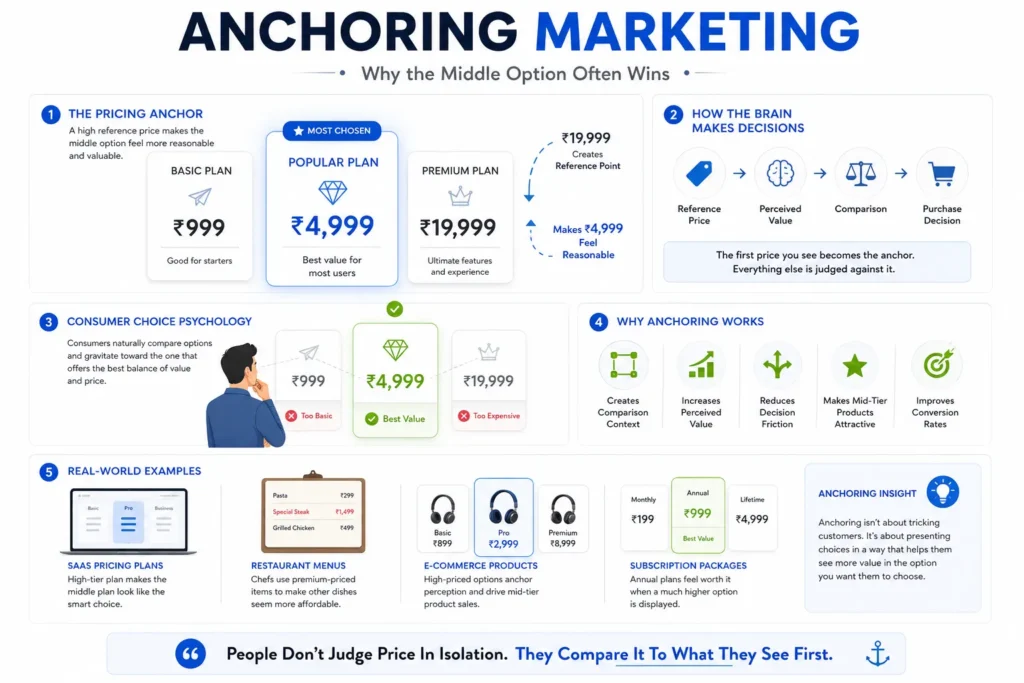
This simple example demonstrates the power of Anchoring Marketing. Consumers rarely evaluate prices in isolation. Instead, they compare prices against a reference point, known as an anchor. The first number they encounter often becomes the benchmark against which all future prices are judged.
This psychological shortcut influences purchasing decisions every day. From restaurants and e-commerce stores to SaaS pricing pages and luxury brands, businesses use Anchoring Marketing to shape perceptions of value, affordability, and quality.
Understanding Anchoring Marketing helps explain why consumers compare prices, why premium options exist, and why the first price matters far more than most people realize.
What Is Anchoring Marketing?
Anchoring Marketing is a pricing and consumer psychology strategy that uses an initial reference point to influence how consumers perceive subsequent prices.
The concept comes from behavioral economics.
When people make decisions, they often rely heavily on the first piece of information they receive.
That first piece of information becomes the anchor.
Once an anchor is established, consumers unconsciously compare future information against it.
For example:
- First price seen: ₹1,00,000
- Second price seen: ₹60,000
The second option appears affordable because of the first anchor.
Without the anchor, the same ₹60,000 product might feel expensive.
This is why Anchoring Marketing plays such a critical role in pricing strategies across industries.
Why Anchoring Marketing Works
The success of Anchoring Marketing is rooted in how the human brain processes information.
People make thousands of decisions every day.
To save time and mental energy, the brain uses shortcuts.
One of those shortcuts is anchoring.
Rather than evaluating every option objectively, consumers use existing reference points.
The first number they encounter often becomes the benchmark.
This process happens automatically.
Most consumers do not even realize it is occurring.
As a result, Anchoring Marketing can significantly influence purchasing decisions without changing the actual value of a product.
The Psychology Behind Anchoring Marketing
Several psychological principles help explain why it is so effective.
Reference Point Bias
Humans naturally compare information.
When evaluating prices, consumers rarely ask:
“Is this objectively worth ₹50,000?”
Instead, they ask:
“Is this worth ₹50,000 compared to something else?”
The anchor provides that comparison point.
Cognitive Shortcuts
Evaluating every purchase from scratch requires effort.
Anchors simplify decision-making.
Instead of conducting a detailed analysis, consumers rely on relative comparisons.
This makes decisions faster and easier.
Perceived Value
Anchoring Marketing changes perception rather than reality.
The product remains unchanged.
The price remains unchanged.
What changes is how consumers interpret the price.
Perception often matters more than objective value.
Why We Compare Prices
Consumers often believe they compare prices because they want the best deal.
While that is partly true, psychology reveals a deeper explanation.
Humans are uncomfortable evaluating value without context.
Context helps reduce uncertainty.
Anchoring Marketing provides that context.
Consider these examples:
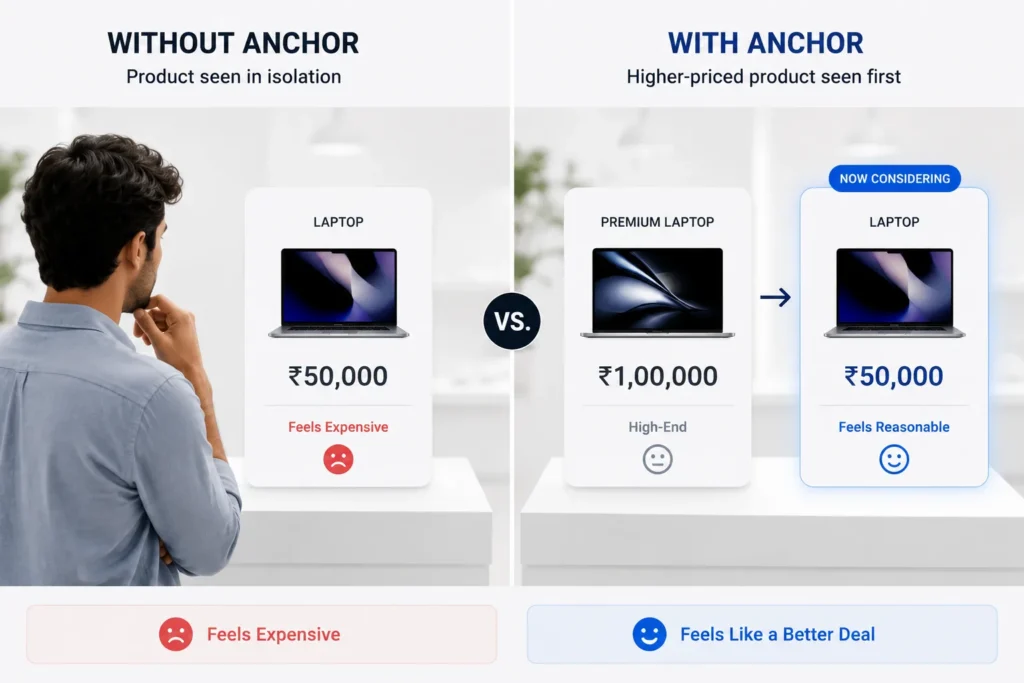
Without an Anchor
A laptop costs ₹75,000.
Is it expensive?
Is it affordable?
It’s difficult to know.
With an Anchor
Laptop A: ₹1,20,000
Laptop B: ₹75,000
Laptop B now feels more affordable.
The first price changes the perception of the second price.
Real-World Examples of Anchoring Marketing
Apple Product Pricing
Apple is a master of Anchoring Marketing.
When launching new products, Apple often presents premium models first.
For example:
- iPhone Pro Max
- iPhone Pro
- Standard iPhone
By introducing the most expensive option first, Apple creates a reference point.
The mid-tier option often appears more reasonable.
This encourages consumers to move toward higher-priced products.
SaaS Pricing Pages
Software companies frequently use Anchoring Marketing.
A typical pricing page may look like:
- Starter: ₹499/month
- Professional: ₹1,999/month
- Enterprise: ₹9,999/month
The Enterprise plan acts as an anchor.
Many customers choose the Professional plan because it feels affordable by comparison.
Restaurant Menus
Restaurants use it extensively.
Example:
- Pasta: ₹499
- Premium Steak: ₹2,499
- Chef’s Signature Steak: ₹5,999
The most expensive item influences how customers perceive the other options.
Many customers select the middle option because it feels like the best value.
Real Estate
Property agents often show expensive homes first.
Once buyers see premium properties, moderately priced homes appear more attractive.
This is another example of Anchoring Marketing in action.
The Decoy Effect and Anchoring Marketing
The Decoy Effect is closely related to Anchoring Marketing.
A decoy option is intentionally designed to influence choices.
Example:
Option A
Small Coffee – ₹150
Option B
Medium Coffee – ₹250
Option C
Large Coffee – ₹280
Many customers choose the Large Coffee because it appears to offer significantly better value.
The Medium option serves as a decoy.
The anchor shifts perception.
As a result, consumers spend more.
Anchoring Marketing in E-Commerce
Online retailers use Anchor Marketing constantly.
Common examples include:
Original Price vs Discounted Price
₹10,000 → ₹5,999
The original price becomes the anchor.
The discounted price feels more attractive.
Premium Product First
Retailers often display expensive products before showing affordable alternatives.
This influences perceived value.
Product Bundles
Bundle pricing frequently relies on Anchoring Marketing to increase average order value.
Anchoring Marketing and Consumer Psychology
Anchoring Marketing works because humans evaluate information relatively rather than absolutely.
Consumers often rely on:
- Previous prices
- Competitor prices
- Suggested retail prices
- Premium options
These references help shape decisions.
This principle connects strongly with:
- Social Proof Marketing: The Hidden Reason People Follow the Crowd
- Loss Aversion Marketing: The Hidden Reason People Hate Losing
- Scarcity Marketing: Why Limited Offers Feel More Valuable
- Emotional Marketing: Why Great Ads Make You Feel Something
- Many Choices: The Surprising Reason More Choices Can Hurt Sales
Understanding these psychological principles helps marketers create more effective campaigns.
When Anchoring Marketing Works Best
Anchoring Marketing is particularly effective when:
- Consumers lack pricing expertise.
- Products have multiple pricing tiers.
- Comparisons are easy to understand.
- Purchase decisions involve uncertainty.
- Products are premium or aspirational.
Industries that frequently use Anchor Marketing include:
- Technology
- Retail
- Real Estate
- Hospitality
- SaaS
- Luxury Goods
When Anchoring Marketing Fails
Despite its effectiveness, Anchoring Marketing can fail.
Unrealistic Anchors
If prices appear absurdly high, consumers may lose trust.
Poor Product Value
Anchors cannot compensate for weak products.
Inconsistent Pricing
Consumers quickly recognize manipulation.
Excessive Complexity
Too many options can create confusion rather than clarity.
Ethical Anchoring Marketing
Ethical Anchoring Marketing helps consumers evaluate options. Unethical Anchoring Marketing attempts to deceive consumers.
Ethical examples:
- Genuine premium products
- Transparent comparisons
- Real discounts
Unethical examples:
- Fake original prices
- Artificially inflated anchors
- Misleading comparisons
Trust remains essential for long-term success.
What Marketers Can Learn From Anchoring Marketing
The biggest lesson is simple:
Consumers do not judge prices in isolation.
They judge prices relative to other prices.
This means businesses should think carefully about:
- Product ordering
- Pricing pages
- Premium offerings
- Discount strategies
- Package design
Small changes in presentation can significantly influence perception.
Common Myths About Anchoring Marketing
Myth 1: Consumers Always Choose the Cheapest Option
Reality: Consumers often choose what feels like the best value.
Myth 2: Anchoring Marketing Is Manipulation
Reality: Ethical Anchor Marketing helps consumers make comparisons.
Myth 3: Anchoring Only Works for Expensive Products
Reality: Anchoring influences decisions at nearly every price point.
Myth 4: Consumers Notice Every Anchor
Reality: Most Anchor Marketing works subconsciously.
Key Takeaways
- Anchoring Marketing influences how consumers compare prices.
- The first number people see often becomes a reference point.
- Anchors shape perceived value and affordability.
- Apple, SaaS companies, restaurants, and retailers use Anchoring extensively.
- The Decoy Effect often works alongside Anchoring.
- Ethical Anchoring improves decision-making.
- Understanding Anchoring helps businesses increase conversions without changing products.
Conclusion
The hidden reason we compare prices is not simply to find the cheapest option.
It is because the human brain naturally seeks reference points.
Anchoring Marketing leverages this tendency by shaping how consumers evaluate value, affordability, and purchasing decisions.
The first number people see often influences every number that follows.
Whether you’re buying a smartphone, choosing a restaurant meal, comparing SaaS subscriptions, or evaluating a property, anchors are constantly shaping your perceptions.
For marketers, understanding Anchoring offers a powerful opportunity.
Not to manipulate consumers.
But to present value more effectively.
Because in many cases, changing perception is more powerful than changing price.
Read More on AdsInteli