

Understanding Scarcity Marketing can help marketers create more effective campaigns and help consumers recognize the psychological forces influencing their decisions.
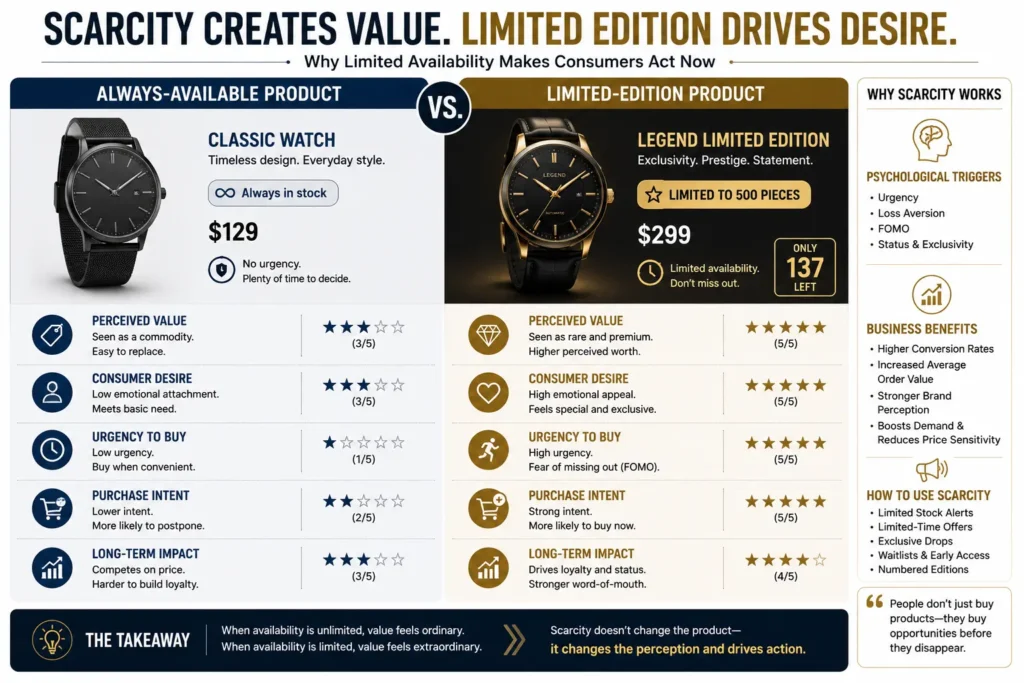
Imagine two watches sitting side by side in a store. Both watches have the same design.
The same quality.
The same materials.
The same price.
The only difference is this:
The first watch is available all year.
The second watch is a limited-edition release with only 500 units available worldwide.
Suddenly, the second watch feels more desirable.
More valuable.
More special. But why? The product itself hasn’t changed. What changed is our perception. This is the power of Scarcity Marketing.
Every day, businesses use scarcity to influence consumer decisions. Whether it’s a flash sale ending at midnight, a hotel room with “Only 2 rooms left” displayed on the booking page, or a limited-edition sneaker launch, scarcity changes how people think, feel, and act.
The reason Scarcity Marketing works isn’t because products become objectively better when they’re scarce. Instead, scarcity changes how our brains assign value.
What Is Scarcity Marketing?
Scarcity Marketing is a marketing strategy that increases perceived value by limiting availability.
The principle is simple:
People tend to value things more when they believe those things are rare, exclusive, or difficult to obtain.
In advertising, scarcity is often created through:
- Limited-time offers
- Limited stock
- Exclusive memberships
- Seasonal products
- Invite-only access
- Product launches
- Flash sales
- Limited editions
The goal of Scarcity Marketing is to encourage consumers to take action before an opportunity disappears.
Instead of thinking:
“I can always buy this later.”
Consumers begin thinking:
“What if it’s gone tomorrow?”
That small shift in mindset can dramatically influence purchasing behavior.
The Strange Way Humans Assign Value
One of the most fascinating aspects of human psychology is that people often value scarcity more than abundance.
Consider diamonds.
Diamonds are valuable largely because they are perceived as rare.
Now consider water.
Water is essential for survival.
Yet in many places, water costs less than diamonds.
Why?
Because value is not determined solely by usefulness.
Value is heavily influenced by availability.
The scarcer something appears, the more valuable it often feels.
This principle applies to products, services, experiences, memberships, and even information.
Scarcity Marketing takes advantage of this psychological tendency by making opportunities feel limited.
Why Scarcity Marketing Works So Well
Many marketing strategies come and go.
Yet Scarcity Marketing has remained effective for decades because it aligns with fundamental human behavior.
Scarcity Marketing Increases Perceived Value
When something is difficult to obtain, people often assume it must be valuable.
This perception influences everything from luxury goods to concert tickets.
Examples include:
- Limited-edition sneakers
- Exclusive memberships
- Premium product launches
- Collectibles
The product may not actually be better.
However, scarcity makes it feel more important.
Scarcity Marketing Creates Urgency
Consumers naturally delay decisions.
They postpone purchases.
They tell themselves they’ll come back later.
Scarcity interrupts this behavior.
A message such as:
“Offer ends tonight”
forces consumers to evaluate the opportunity immediately.
This urgency reduces procrastination and increases action.
Scarcity Marketing Activates FOMO
Scarcity and FOMO are closely related.
FOMO, or Fear of Missing Out, occurs when people worry about losing access to something valuable.
When consumers see:
- Limited stock
- Countdown timers
- Exclusive access
they begin imagining the consequences of missing the opportunity.
This emotional reaction often increases motivation to act.
The Psychology Behind Scarcity Marketing
The effectiveness of Scarcity Marketing is rooted in several powerful psychological principles.
Loss Aversion
Research consistently shows that people dislike losses more than they enjoy equivalent gains.
Imagine two messages:
- Save ₹1,000 today.
- Lose your ₹1,000 discount if you wait.
Most people react more strongly to the second message.
This phenomenon is known as loss aversion.
Scarcity Marketing frequently frames inaction as a potential loss.
Consumers become motivated to avoid losing opportunities.
Opportunity Cost
When scarcity exists, consumers start thinking about what they might lose.
Questions begin to appear:
- What if I miss this deal?
- What if the product sells out?
- What if prices increase later?
These thoughts increase the perceived importance of acting quickly.
Exclusivity
People often desire things that feel exclusive.
Limited access creates status.
Examples include:
- VIP memberships
- Invite-only communities
- Early access programs
- Premium product launches
Exclusivity makes people feel part of a select group.
This feeling increases desirability.
Status Signaling
Scarce products often function as status symbols.
Limited-edition products communicate rarity.
Owning something that few others can obtain can create social value.
Luxury brands frequently leverage this aspect of Scarcity Marketing.
Types of Scarcity Marketing
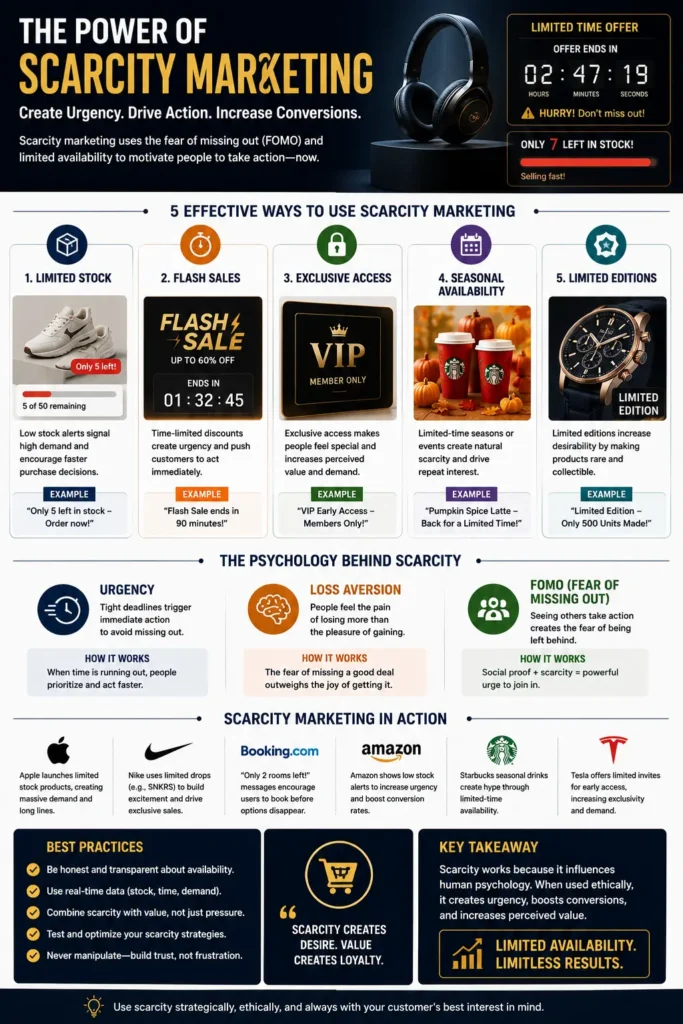
Time-Based Scarcity
This is one of the most common forms of Scarcity Marketing.
Examples include:
- Flash sales
- Black Friday deals
- Weekend offers
- Countdown timers
The opportunity is available only for a limited period.
Consumers feel pressure to act before time runs out.
Quantity-Based Scarcity
Examples include:
- Only 5 left in stock
- Limited inventory
- Limited production runs
This type of scarcity focuses on availability rather than time.
Consumers worry that demand may exceed supply.
Access-Based Scarcity
Not everyone receives access.
Examples include:
- VIP memberships
- Invite-only programs
- Exclusive launches
- Early access events
Restricted access increases perceived value.
Seasonal Scarcity
Certain products are available only during specific periods.
Examples include:
- Holiday collections
- Festival promotions
- Seasonal menu items
Consumers know the opportunity will disappear after the season ends.
Read More Articles On Advertising Psychology
Real-World Examples of Scarcity Marketing
Nike Sneaker Drops
Nike frequently releases limited-edition sneakers.
Supply is intentionally restricted.
Demand often exceeds availability.
As a result:
- Products sell out quickly.
- Resale prices increase dramatically.
- Brand excitement grows.
This is Scarcity Marketing in action.
Apple Product Launches
Apple rarely labels its launches as scarcity campaigns.
Yet scarcity often appears naturally.
New products launch with:
- Limited availability
- Pre-order windows
- High demand
Consumers feel urgency to secure products before inventory runs out.
Amazon Lightning Deals
Amazon’s Lightning Deals combine:
- Time-based scarcity
- Quantity-based scarcity
Consumers see:
- Limited quantities
- Countdown timers
These signals encourage immediate action.
Booking Platforms
Travel websites frequently display messages such as:
- Only 1 room left
- Booked 12 times today
- High demand for this property
These scarcity indicators reduce hesitation and increase bookings.
When Scarcity Marketing Works Best
Scarcity Marketing is particularly effective when:
- Scarcity is genuine.
- Products already provide value.
- Consumers are interested.
- Competition exists.
- Timing matters.
Scarcity amplifies value.
It does not create value from nothing.
When Scarcity Marketing Fails
Despite its effectiveness, Scarcity Marketing can backfire.
Fake Scarcity
Consumers are increasingly aware of marketing tactics.
If a product always claims to have “Only 3 Left,” trust erodes quickly.
Overusing Scarcity
Every offer cannot be urgent.
When consumers encounter scarcity constantly, they become less responsive.
Weak Products
Scarcity may generate attention initially.
However, poor products eventually damage trust.
Long-term success still depends on delivering value.
Scarcity Marketing vs FOMO Marketing
Many people use these terms interchangeably.
However, they are not identical.
Scarcity Marketing
Focuses on limited availability.
Example:
Only 10 items left.
FOMO Marketing
Focuses on emotional fear.
Example:
Don’t miss your chance.
Scarcity often creates FOMO.
But FOMO can exist even without physical scarcity.
Understanding the difference helps marketers apply each strategy more effectively.
What Marketers Can Learn From Scarcity Marketing
The biggest lesson is simple:
Scarcity amplifies value.
It does not create value.
Successful marketers use scarcity to highlight genuine opportunities.
They do not rely on manipulation.
Best practices include:
- Be honest about limitations.
- Use scarcity strategically.
- Focus on authentic value.
- Build trust before creating urgency.
Consumers respond best when scarcity feels real.
Common Myths About Scarcity Marketing
Myth 1: Scarcity Marketing Works on Everyone
Reality: Consumers respond differently based on awareness, trust, and experience.
Myth 2: More Scarcity Always Means More Sales
Reality: Excessive scarcity can create skepticism.
Myth 3: Fake Scarcity Is Harmless
Reality: False scarcity damages credibility.
Myth 4: Scarcity Marketing Can Replace Product Quality
Reality: Scarcity attracts attention. Quality creates loyalty.
Key Takeaways
- Scarcity Marketing increases perceived value through limited availability.
- Scarcity creates urgency and reduces procrastination.
- Loss aversion plays a major role in consumer behavior.
- Scarcity often triggers FOMO.
- Genuine scarcity builds trust.
- Artificial scarcity can damage brands.
- Scarcity amplifies value but does not create value.
Conclusion
The reason limited offers feel more valuable has very little to do with the product itself.
Instead, it has everything to do with human psychology.
When opportunities appear limited, our brains assign greater importance to them. Scarcity captures attention, increases urgency, triggers fear of loss, and changes how consumers evaluate value.
That is why a limited-edition sneaker sells out in minutes.
Why a countdown timer increases conversions.
Why a hotel room feels more desirable when only one remains available.
The most successful marketers understand a simple truth:
Scarcity does not create value. It reveals value people might otherwise ignore.
That is why Scarcity Marketing remains one of the most powerful principles in advertising.
FAQ
What is Scarcity Marketing?
Scarcity Marketing is a strategy that increases perceived value by limiting availability through time restrictions, limited quantities, exclusivity, or access controls.
Why does Scarcity Marketing work?
This works because humans naturally place greater value on opportunities that appear limited or difficult to obtain.
What are examples of Scarcity Marketing?
Examples include flash sales, limited stock alerts, exclusive memberships, product launches, and limited-edition products.
Is Scarcity Marketing ethical?
Yes, when scarcity is genuine. Artificial or misleading scarcity can damage trust and brand credibility.
Can Scarcity Marketing increase conversions?
Yes. By creating urgency and reducing procrastination, this often improves engagement and conversion rates.