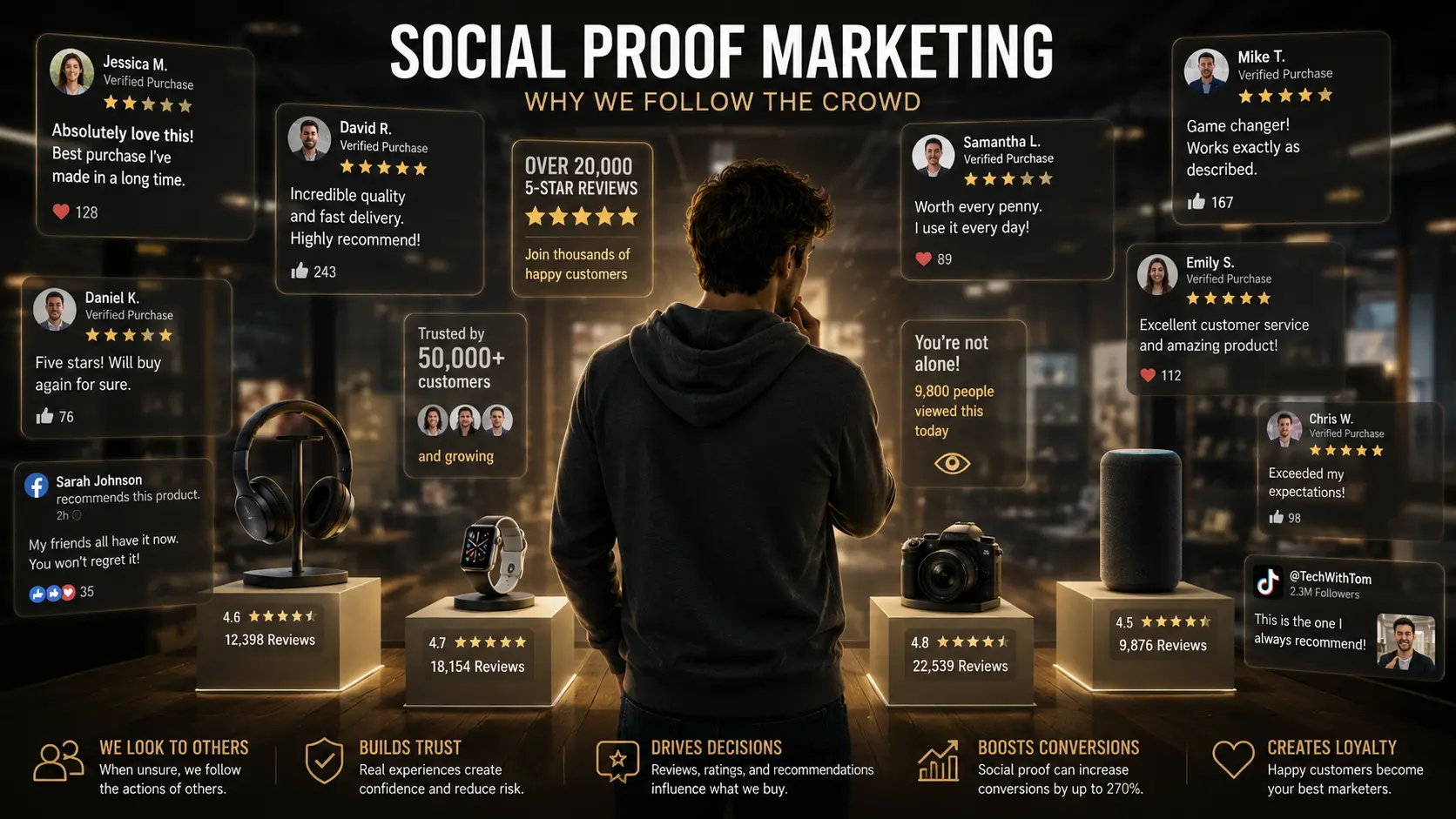

Why do people choose a crowded restaurant over an empty one? Why do products with thousands of reviews often outsell similar products with few reviews? Why do consumers trust recommendations from strangers they have never met? The answer lies in Social Proof Marketing, one of the most powerful principles in consumer psychology and advertising.
Every day, people face countless decisions. Whether they are choosing a hotel, purchasing a smartphone, selecting a software platform, or deciding which restaurant to visit, uncertainty often influences their choices. Rather than analyzing every option independently, people frequently look at what others are doing.
This behavior forms the foundation of Social Proof Marketing.
The hidden reason people follow the crowd is not because they lack intelligence or independent thinking. Instead, it is a deeply rooted psychological mechanism that has helped humans survive, learn, and make decisions for thousands of years.
Today, marketers use Social Proof Marketing to build trust, reduce uncertainty, and influence consumer behavior. Understanding why it works can help businesses create more effective advertising while helping consumers understand how their decisions are shaped.
What Is Social Proof Marketing?
Social Proof Marketing is a marketing strategy that uses the actions, opinions, experiences, and endorsements of other people to influence purchasing decisions.
The concept is simple:
When people are uncertain, they look to others for guidance.
Consumers often assume that if many people trust a product, service, or brand, there is probably a good reason.
Examples of Social Proof Marketing include:
- Customer reviews
- Product ratings
- Testimonials
- Case studies
- Influencer recommendations
- Celebrity endorsements
- User-generated content
- Best Seller badges
- Popular product labels
- Trending content indicators
These signals help consumers feel more confident about their choices.
Why Social Proof Marketing Works So Well
One of the biggest challenges consumers face today is information overload.
Every day, people are exposed to:
- Thousands of advertisements
- Hundreds of products
- Endless recommendations
- Multiple competing brands
Evaluating every option requires significant effort.
As a result, the brain looks for shortcuts.
Social Proof Marketing provides one of the most effective shortcuts available.
When consumers see evidence that other people have already made a decision, they often feel more comfortable making the same choice.
This reduces uncertainty and speeds up decision-making.
The Psychology Behind Social Proof Marketing
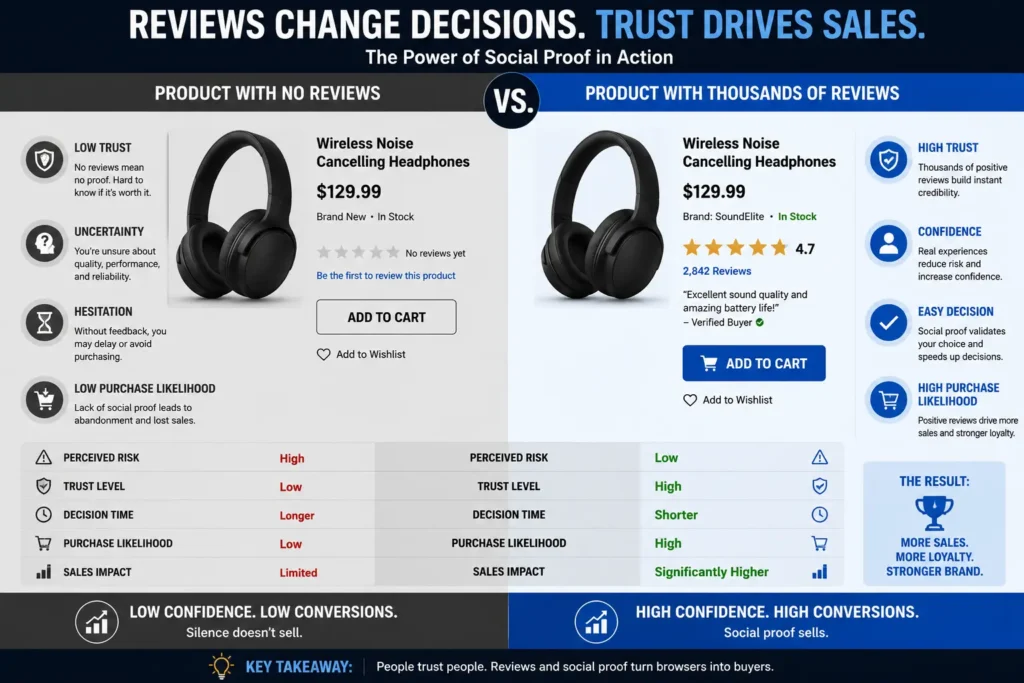
The effectiveness of Social Proof Marketing comes from several powerful psychological principles.
Social Proof Marketing Reduces Uncertainty
Humans dislike uncertainty.
Whenever people encounter unfamiliar situations, they naturally seek guidance.
Examples include:
- Buying a product for the first time
- Booking a hotel in another country
- Choosing an online course
- Selecting business software
Questions immediately arise:
- Is this trustworthy?
- Will it work?
- Is it worth the money?
- What do other people think?
Reviews, testimonials, and ratings provide answers.
This is why Social Proof Marketing becomes especially powerful when consumers face unfamiliar decisions.
Social Proof Marketing Creates Trust
Trust is one of the most valuable assets in advertising.
The challenge is that trust takes time to build.
Consumers often borrow trust from others.
For example:
- A product with 50,000 positive reviews appears more trustworthy.
- A software platform used by major companies feels more reliable.
- A recommendation from a respected expert carries more credibility.
This process is known as trust transfer.
The trust consumers place in other people becomes associated with the brand itself.
This is one of the primary reasons Social Proof Marketing is so effective.
Social Proof Marketing Activates Herd Behavior
Psychologists describe herd behavior as the tendency to follow collective actions.
People often assume:
“If many others are doing this, there must be a good reason.”
This principle influences:
- Purchasing decisions
- Technology adoption
- Fashion trends
- Restaurant choices
- Entertainment preferences
Popularity creates perceived value.
That perceived value can significantly influence consumer behavior.
Social Proof Marketing Provides Social Validation
Humans naturally seek acceptance and belonging.
People often feel more confident when their choices align with those of others.
Following popular options provides reassurance.
Consumers may think:
- Thousands of people bought this product.
- Millions use this platform.
- Everyone is talking about this brand.
These signals create confidence and reduce perceived risk.
Read More Articles on Advertising Intelligence
Types of Social Proof Marketing Used by Brands
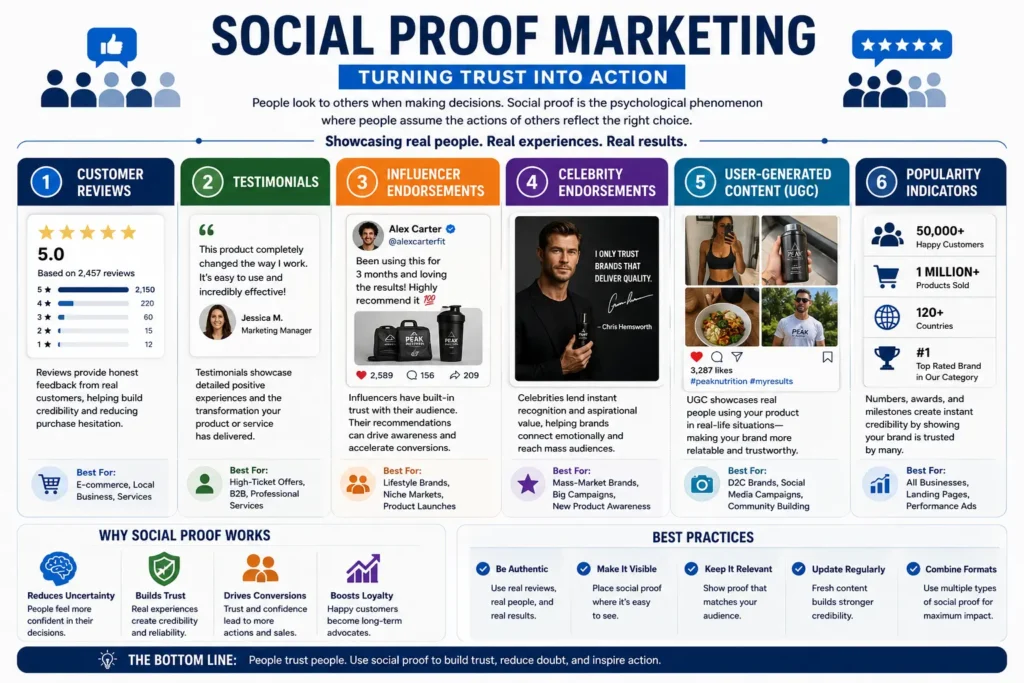
Customer Reviews
Customer reviews remain one of the strongest forms of Social Proof Marketing.
Consumers frequently read reviews before making purchasing decisions.
Reviews help answer important questions and reduce uncertainty.
Testimonials
Testimonials provide detailed customer experiences.
Unlike simple ratings, testimonials tell stories.
Because humans connect strongly with stories, testimonials often create deeper trust.
Influencer Recommendations
Influencers build credibility within specific communities.
When they recommend products, followers often perceive the recommendation as genuine advice rather than advertising.
Celebrity Endorsements
Brands have used celebrities for decades.
Athletes, actors, and public figures transfer authority, recognition, and credibility to products and services.
User-Generated Content
Consumers often trust other consumers more than brands.
Photos, videos, reviews, and social media posts created by customers provide authentic forms of SPF.
Popularity Indicators
Examples include:
- Best Seller
- Most Popular
- Trending Now
- Trusted by 1 Million Customers
- Top Rated Product
These indicators encourage consumers to follow collective behavior.
Real-World Examples of Social Proof Marketing
Amazon
Amazon prominently displays:
- Product ratings
- Customer reviews
- Best Seller badges
- Purchase statistics
These features help consumers make faster purchasing decisions.
Airbnb
Airbnb relies heavily on:
- Host reviews
- Guest ratings
- Verified experiences
Without social proof, trust between hosts and guests would be significantly harder to establish.
Netflix
Netflix frequently highlights:
- Trending content
- Top 10 rankings
- Most-watched shows
These indicators encourage users to follow popular viewing choices.
Apple
Apple benefits from social proof through visibility and widespread adoption.
When millions of people use a product, ownership itself becomes a powerful form of SPF.
When Social Proof Marketing Works Best
Social Proof Marketing is particularly effective when:
- Consumers are unfamiliar with products
- Purchasing decisions involve risk
- Multiple choices are available
- Trust plays an important role
- Products require consideration
The greater the uncertainty, the stronger the influence of social proof.
When Social Proof Marketing Fails
Despite its effectiveness, Social Proof Marketing is not perfect.
It can fail when:
- Reviews appear fake
- Testimonials feel scripted
- Statistics seem misleading
- Popularity claims lack evidence
- Consumers suspect manipulation
Trust is the foundation of social proof.
Without trust, social proof loses its power.
Ethical Social Proof Marketing
Ethical marketers use genuine customer experiences.
Examples include:
- Verified reviews
- Real testimonials
- Authentic case studies
- Genuine customer stories
Unethical practices include:
- Fake reviews
- Purchased followers
- Artificial engagement
- Misleading statistics
While deceptive tactics may produce short-term gains, they often damage long-term trust.
The most successful brands use SPF responsibly.
What Marketers Can Learn From Social Proof Marketing
The biggest lesson is simple:
People trust people.
Consumers often trust other customers before they trust brands.
This is why SPF remains one of the most effective advertising principles.
Rather than focusing solely on promotional messages, businesses should focus on:
- Customer experiences
- Testimonials
- Success stories
- Authentic reviews
- Community engagement
Trust is often more valuable than attention.
Common Myths About Social Proof Marketing
Myth 1: Social Proof Marketing Only Works Online
Reality: Social proof influences both online and offline decisions.
Myth 2: More Reviews Always Mean Better Results
Reality: Authenticity matters more than volume.
Myth 3: Social Proof Marketing Can Replace Product Quality
Reality: Social proof may attract customers initially, but quality determines long-term success.
Myth 4: Social Proof Marketing Only Works for Large Brands
Reality: Small businesses can leverage reviews, testimonials, and customer stories effectively.
Key Takeaways
- Social Proof Marketing helps consumers make decisions by reducing uncertainty.
- Reviews, testimonials, and endorsements build trust.
- Humans naturally follow collective behavior when making decisions.
- Social proof works because it leverages trust, validation, and psychological shortcuts.
- Authenticity is critical for long-term effectiveness.
- Ethical SPF strengthens brand credibility.
Conclusion
The hidden reason people follow the crowd is deeply rooted in human psychology.
For thousands of years, observing the behavior of others helped humans avoid risks, learn faster, and make better decisions. Today, those same instincts influence how people shop, choose brands, consume content, and make purchasing decisions.
This is why Social Proof Marketing continues to be one of the most effective tools in advertising.
When consumers see evidence that others trust a product, they feel more confident making the same choice. Reviews, testimonials, recommendations, and popularity signals all help reduce uncertainty and increase trust.
The brands that understand Social Proof Marketing can build stronger relationships, improve conversions, and create greater customer confidence.
In a world filled with endless choices, people still look to other people for answers—and that simple truth explains why the crowd remains so influential.
FAQ
What is Social Proof Marketing?
SPF is a strategy that uses reviews, ratings, testimonials, endorsements, and customer experiences to influence consumer decisions.
Why does Social Proof Marketing work?
SPF works because people naturally look to others for guidance when making decisions, especially when uncertainty is involved.
What are examples of Social Proof Marketing?
Examples include customer reviews, testimonials, influencer recommendations, celebrity endorsements, user-generated content, and best-seller labels.
Is Social Proof Marketing ethical?
Yes, when it uses genuine customer experiences and authentic information. Fake reviews and misleading claims are unethical.
Can Social Proof Marketing increase conversions?
Yes. By reducing uncertainty and increasing trust, SPF can significantly improve conversion rates and customer confidence.