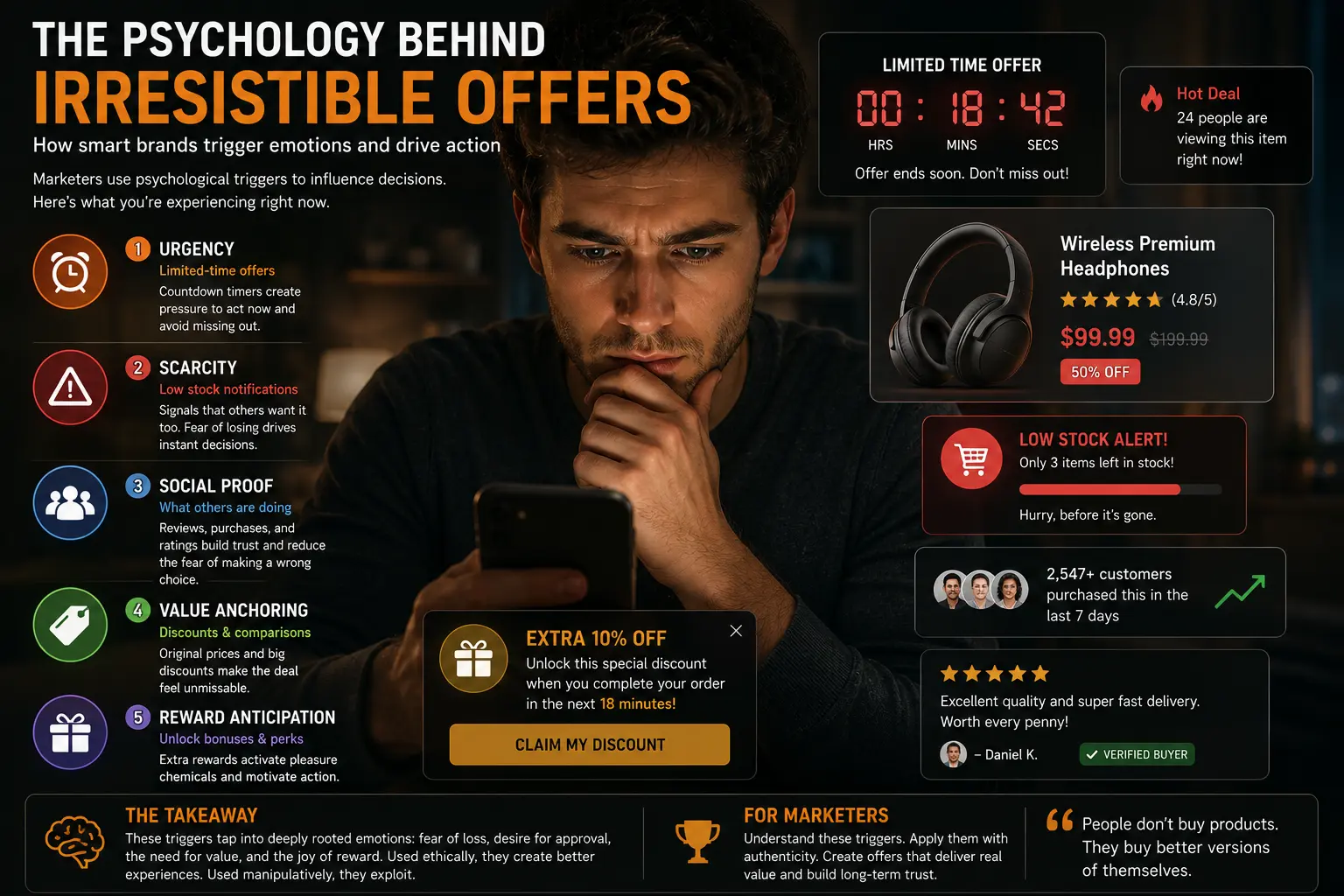

Imagine you’re browsing an online store with no intention of buying anything. Suddenly, you see a message: “Only 2 items left in stock.” A few minutes later, another notification appears: “15 people are viewing this product right now.” Then comes the final push: “Sale ends in 03:59:42.” Without realizing it, your brain shifts from curiosity to urgency. What was once an optional purchase now feels like an opportunity that could disappear at any moment. This emotional response is known as FOMO Marketing, one of the most powerful psychological techniques used in modern advertising.
From e-commerce websites and travel platforms to streaming services and software companies, marketers regularly leverage the fear of missing out to encourage action.
But why does FOMO work so well?
Why do humans dislike missing opportunities, even when they were not interested initially?
The answer lies deep within human psychology.
What Is FOMO Marketing?
FOMO stands for Fear of Missing Out.
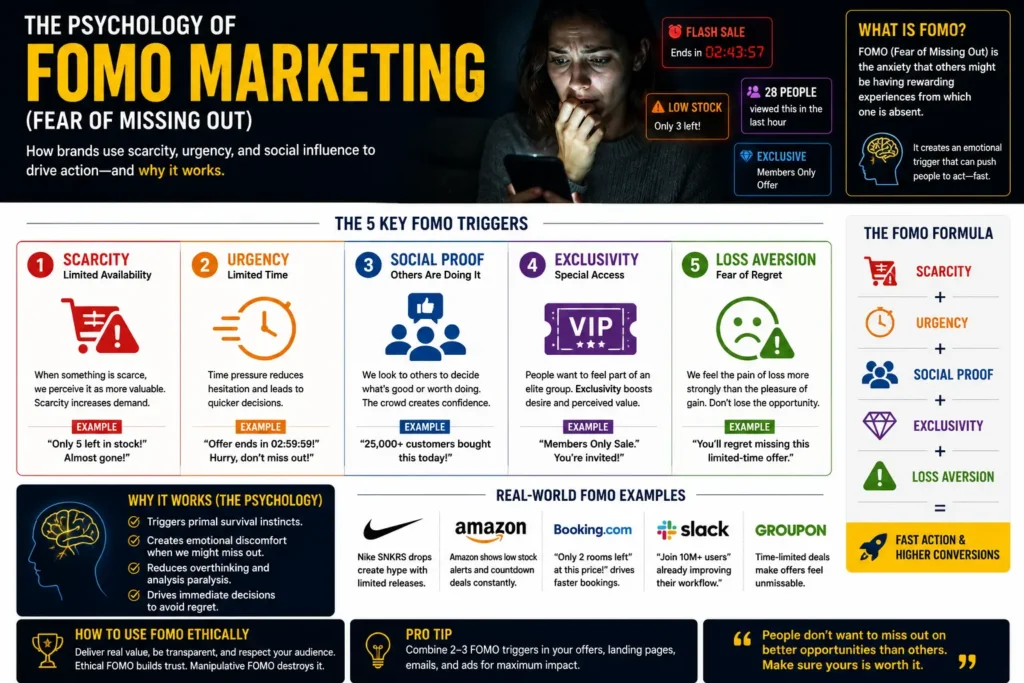
In marketing, FOMO refers to strategies designed to create urgency, exclusivity, or scarcity that encourage consumers to act before an opportunity disappears.
Common examples include:
- Limited-time offers
- Flash sales
- Early-bird pricing
- Exclusive memberships
- Waitlists
- Limited stock notifications
- Product drops
- Countdown timers
The goal is simple:
Create the feeling that delaying a decision may result in losing something valuable.
When consumers perceive scarcity, they often place greater value on the opportunity.
Why Humans Hate Missing Out
To understand FOMO marketing, we must first understand human nature.
The fear of missing out is not a modern phenomenon.
It existed long before online shopping and social media.
Our brains evolved in environments where missing opportunities could have serious consequences.
Missing food.
Missing social connections.
Missing protection.
Missing important information.
Throughout history, those who paid attention to opportunities often had a better chance of survival.
Although modern life is different, our psychological wiring remains remarkably similar.
As a result, the possibility of missing something valuable still creates discomfort.
The Psychology Behind FOMO Marketing
Scarcity Makes Things Feel More Valuable
One of the most studied concepts in consumer psychology is the Scarcity Principle.
When something becomes less available, people tend to value it more.
Consider two situations:
Situation A
A product is always available.
Situation B
The same product is available for only 24 hours.
Most people perceive Situation B as more valuable.
Nothing about the product changed.
Only its availability changed.
Scarcity creates urgency because people fear losing access.
This is why marketers frequently use messages such as:
- Only 5 left
- Sale ends tonight
- Limited edition
- Available while supplies last
The possibility of losing access increases desire.
Read More Articles On Advertising Psychology
Loss Aversion Is Stronger Than Potential Gain
Research consistently shows that people dislike losses more than they enjoy equivalent gains.
This concept is known as Loss Aversion.
Imagine two messages:
Message A
Save ₹1,000 today.
Message B
Lose ₹1,000 if you wait.
Most people react more strongly to the second message.
The emotional impact of loss tends to be greater than the emotional impact of gain.
FOMO marketing leverages this principle by framing inaction as a potential loss.
Consumers begin thinking:
“What if I miss this opportunity?”
rather than
“Do I actually need this?”
Social Proof Increases FOMO
Humans are social creatures.
We often look to others when making decisions.
This behavior is known as Social Proof.
Examples include:
- 50,000 customers purchased this product
- Trending now
- Best-selling item
- Most popular choice
- 120 people booked today
When consumers see others participating, they assume there is value in the opportunity.
No one wants to be left behind while everyone else benefits.
This is one reason social proof and FOMO work so well together.
Exclusivity Creates Desire
People naturally value things that feel exclusive.
Exclusive opportunities create status.
Examples include:
- Invite-only communities
- VIP memberships
- Early access programs
- Premium product launches
When access is restricted, demand often increases.
The perception of exclusivity triggers a desire to belong.
Consumers begin seeing the opportunity as something special.
How Brands Use FOMO Marketing
E-Commerce
Online retailers frequently use:
- Flash sales
- Limited stock warnings
- Countdown timers
- Seasonal promotions
Examples:
- Amazon Prime Day
- Black Friday Sales
- Limited Edition Sneaker Drops
These campaigns encourage faster decision-making.
Travel Platforms
Travel websites are masters of FOMO.
Common messages include:
- Only one room left
- Booked 15 times today
- Prices may increase soon
These notifications create urgency and reduce hesitation.
SaaS and Software Companies
Software companies often use:
- Early adopter pricing
- Limited launch offers
- Beta access programs
- Lifetime deals
These tactics encourage users to join before benefits disappear.
Event Marketing
Concerts, conferences, and webinars rely heavily on FOMO.
Examples:
- Limited seats available
- Early-bird pricing ends tomorrow
- Registration closing soon
These messages increase registrations and attendance.
Common FOMO Marketing Techniques
Countdown Timers
Visual reminders that time is running out.
Limited Stock Notifications
Signals scarcity and urgency.
Waitlists
Increase perceived demand and exclusivity.
Early Access Offers
Reward fast action.
Product Launch Drops
Popular among fashion, gaming, and technology brands.
Exclusive Memberships
Create a sense of belonging and status.
When FOMO Marketing Works Best
FOMO marketing is particularly effective when:
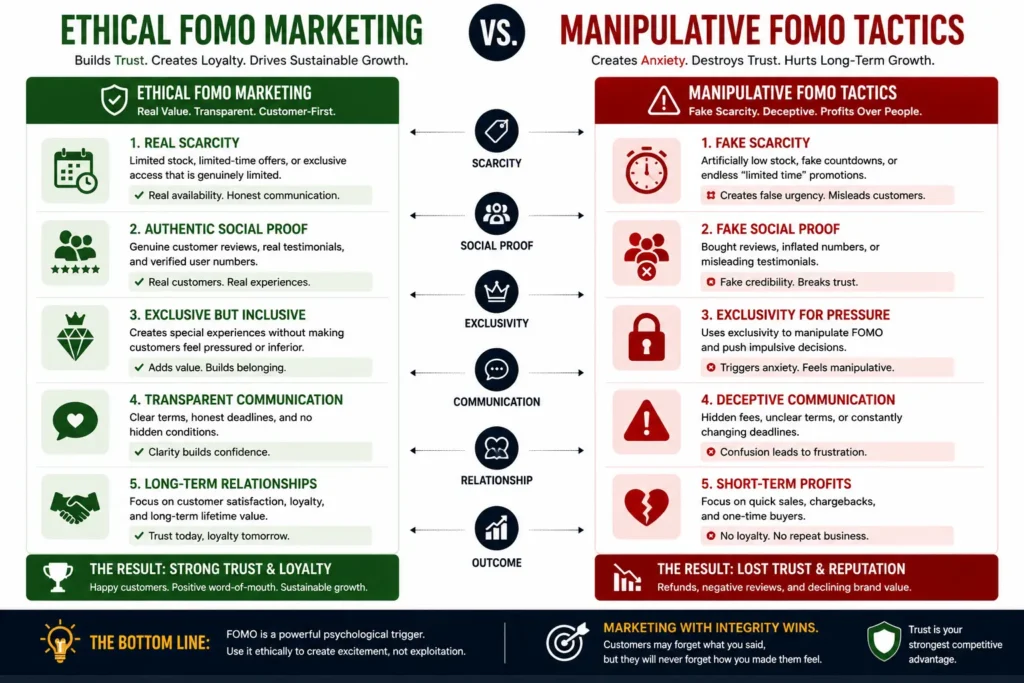
- The offer is genuinely valuable
- Scarcity is real
- The audience already has interest
- Trust exists between brand and consumer
In these situations, urgency helps people make decisions.
When FOMO Marketing Backfires
FOMO can become dangerous when used irresponsibly.
Consumers quickly recognize fake urgency.
Examples include:
- Fake countdown timers
- Artificial scarcity
- Constant “limited-time” offers
- Misleading stock claims
When customers feel manipulated, trust declines.
Short-term sales gains can create long-term brand damage.
The best marketers use urgency honestly.
The Ethics of FOMO Marketing
There is an important difference between persuasion and manipulation.
Ethical FOMO highlights genuine limitations.
Examples:
- Event capacity
- Seasonal availability
- Limited production runs
Unethical FOMO creates false pressure.
Consumers increasingly value transparency.
Brands that maintain trust often outperform those relying on deceptive tactics.
What Marketers Can Learn from FOMO
The biggest lesson is not that urgency sells.
The bigger lesson is that human behavior drives advertising effectiveness.
Successful marketers understand:
- People value scarce opportunities.
- People dislike losses.
- People seek social validation.
- People want to belong.
FOMO works because it taps into these deeply rooted psychological tendencies.
However, the most successful brands use FOMO to amplify genuine value rather than replace it.
Common Myths
Myth 1: FOMO Marketing Only Works on Young People
Reality: People of all ages respond to scarcity and urgency.
Myth 2: More Urgency Always Means More Sales
Reality: Excessive urgency can reduce trust and hurt performance.
Myth 3: FOMO Marketing Works Without Value
Reality: FOMO amplifies value. It cannot replace it.
Key Takeaways
- FOMO Marketing leverages the fear of missing opportunities.
- Scarcity increases perceived value.
- Loss aversion makes people fear missing out.
- Social proof reinforces urgency.
- Exclusivity creates demand.
- Ethical FOMO builds trust while encouraging action.
- Long-term success requires genuine value.
Conclusion – FOMO marketing
The fear of missing out is deeply rooted in human psychology.
Long before advertising existed, humans were motivated to avoid losing opportunities, resources, and social connections. Modern marketers simply apply these same psychological principles to products, services, and experiences.
When used responsibly, FOMO marketing can help consumers make faster decisions and discover valuable opportunities.
When abused, it can damage trust and weaken brand relationships.
The most effective marketers understand that FOMO is not about creating panic.
It is about highlighting value before an opportunity disappears.
That subtle difference separates great marketing from manipulative marketing.
FAQ
What is FOMO marketing?
FOMO marketing is a strategy that uses scarcity, urgency, exclusivity, and social proof to encourage consumers to act quickly.
Why does FOMO marketing work?
It works because humans naturally dislike losing opportunities and value scarce resources.
What are common examples of FOMO marketing?
Flash sales, limited stock alerts, countdown timers, waitlists, and exclusive offers.
Is FOMO marketing ethical?
Yes, when scarcity and urgency are genuine. Misleading consumers can damage trust.
Can FOMO marketing increase conversions?
Yes. When used appropriately, FOMO can significantly improve engagement, click-through rates, and conversions.